A nonprofit mission video is a short film, about three minutes for a gala and 60 to 90 seconds for the web, that tells a stranger who you serve, why it matters, and what your work changes, through one real person’s story rather than a list of programs. At a gala it opens the program, right after the welcome, so the room knows why it’s there before anyone asks for money. Shoot it once, plan the cuts before you film, and the same footage serves your website, grant applications and board recruiting for the rest of the year.
This guide is part of our nonprofit gala video series, which covers every film a gala night needs.
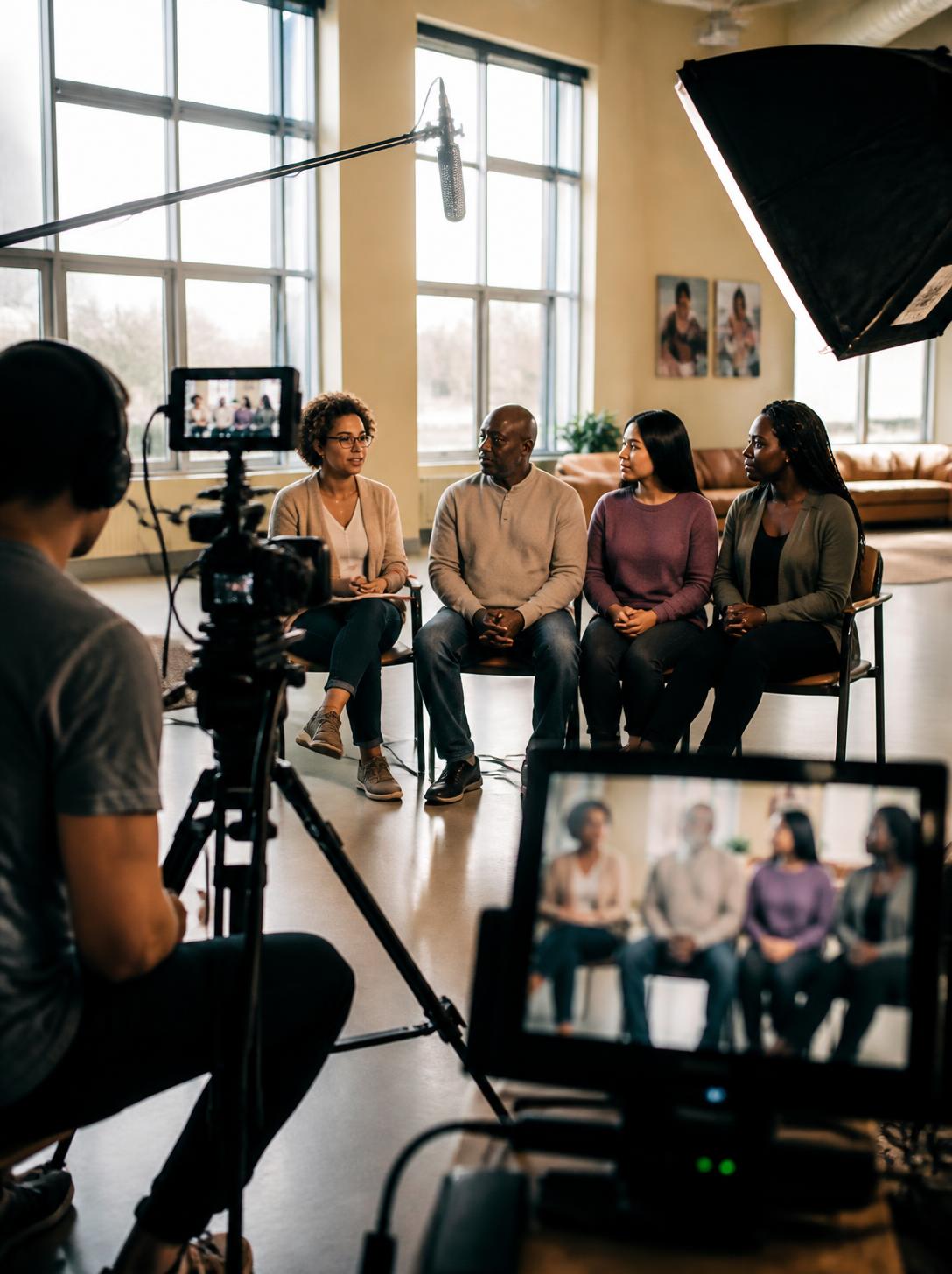
What does a nonprofit mission video actually do?
A mission video introduces your organization to someone who has never heard of it. It answers three questions: why you exist, whom you serve, and how you serve them. It doesn’t ask for a specific gift. That job belongs to an appeal or fund-a-need film.
The advice to make one is old and consistent. In a Chronicle of Philanthropy roundup of expert advice, Evan Von Leer of the Elizabeth Glaser Pediatric AIDS Foundation put it this way: “This video is one of the most useful you can have to introduce people to your organization, appeal to donors, and show at events.” The foundation’s own mission video was built on a single emotional element: “a mother’s love for her children,” the reason the foundation was created.
At a gala the need is sharper. Fundraising consultant Claire Axelrad, writing for Bloomerang, argues that “Every Gala needs a period where your mission takes center stage,” and warns there’s “no greater waste of time than holding an event where guests leave not really knowing who put the whole thing together.” Many guests came because a friend bought a table. The mission video is how they meet you.
How long should a nonprofit mission video be?
It depends on the screen. The published advice splits cleanly between web and ballroom:
- For the web: Yans Media, a nonprofit video agency, recommends 60 to 90 seconds for a homepage mission video and says it “can stretch to 2 minutes if needed.” Candid’s guide to explainer videos aims for “90 seconds or less.”
- For a gala: benefit auctioneer Murad Auctions says the event video “should be no longer than three minutes.” Levitate Media, an agency, suggests 2 to 4 minutes for galas. Producer Joe Fox, in Nonprofit Quarterly, suggests “4-5 minute videos for galas and events.”
Our position: aim for about three minutes in the ballroom, and treat four as a ceiling. A seated room will give you that much attention, but the mission video is the first of several films that night, and your fund-a-need film and honoree tributes still need the room’s patience. YouTube’s Ramya Raghavan, quoted in the Chronicle, offered a useful test: “If you can’t get your message out in a couple of minutes, you may want to revisit your messaging.”
What should a mission video include?
One person, one story, and enough context for the story to stand for the whole organization. Levitate’s advice is blunt: “Skip the logo opener. Start with a real person in a real moment.” Candid’s structure runs from the problem to your solution, your process, and a human story. For a gala opener we’d put the person first and build out from there:
- Open on a person, not a logo. Ten seconds of someone your mission serves, in their own words, in a real place.
- Name the problem at the scale your community lives with it. One number, said plainly and sourced, is enough.
- Show the work. Real program footage: the classroom, the clinic hallway, the van on its Saturday route.
- Return to the person. What changed for them, specifically.
- Widen the frame. Show that this story repeats across the people you serve, without turning it into a slideshow of statistics.
- End on tonight. A closing line that hands the room to the emcee, such as “That’s why we’re all here.”
Revisit that last beat when you script the emcee. The first words after the video should pick up its final line, not start a new topic. That’s the cheapest way to make a film and a live program feel like one evening.
Shoot interviews unscripted. Write the questions, not the answers. Scripted lines from real people sound recited, and gala audiences notice.
Who should be on camera?
Keep it to one main voice and two or three supporting ones. The main voice is ideally someone your mission served, or a family member speaking for them. Supporting voices can be a front-line staff member, a volunteer, or a donor who saw the work up close.
Murad Auctions recommends putting your board chair or executive on camera to speak about the mission. We disagree for the gala cut. Save your executive director for the stage. If they appear in the film and then walk up to speak, the room hears the same voice twice in five minutes, and the live moment loses its weight. For the website version, a short line from your ED at the end works well, because there’s no stage.
Anyone your organization serves needs informed consent before filming. Givebutter’s storytelling guide puts it well: “Make sure participants know they can decline, skip questions, or stop the interview without affecting the support they receive.” Its other tip, “Meet without a camera first,” is worth following for anyone nervous. Our guide to nonprofit storytelling video consent covers releases, minors, and anonymity.
Where should the mission video play in the gala program?
Planners disagree, and the disagreement matters:
- Opening, after the welcome. A webinar run-of-show from Auctria and Groundmaking lists “Welcome and Invocation” and then “Mission Video (50-70% know nothing),” with a separate “Impact Video + Ask” later in the night. The percentage is the presenter’s estimate, not research, but the structure is sound.
- Once everyone is seated. Murad Auctions says the video should be shown “after everyone is seated.”
- After the main course. Bloomerang’s Axelrad lists the mission moment in the program portion of the night, which she says “generally happens after the welcoming remarks and once folks have finished eating their main course,” adding that “It’s best to wait until plates are cleared before starting the program to avoid background noise.”
- Immediately before the ask. MiniMatters, a DC agency, describes its mission videos as “Usually three to five minutes, played immediately before the ask.”
Our recommendation: play the mission video to open the program, right after the welcome, once guests are seated and before main-course service. The slot right before the ask belongs to your fund-a-need film. Showing the mission video there merges two jobs into one film, and putting both films back to back blurs them. Axelrad’s noise point is real, so ask the banquet captain to pause service for the three minutes the film runs. Your honoree tributes go with the awards, away from both, as our honoree tribute video guide explains.
Key takeaway: the mission video opens the night and the fund-a-need film closes the ask. When the budget allows, make them two different films and play them at least one course apart.
How is a mission video different from a fund-a-need film or an explainer?
They’re often confused because all three tell your story. They have different jobs:
| Film | What it does |
|---|---|
| Mission video | Introduces who you are and why it matters About 3 minutes at a gala, 60 to 90 seconds online Opens the program; lives on your homepage all year |
| Fund-a-need film | Makes one case for one gift tonight About 2 minutes, never past 3 Plays immediately before the paddle raise |
| Explainer | Walks through how a program works, often animated 90 seconds or less Website, email, and social |
Levitate draws the same line: “Mission videos explain who you are,” while a fundraising video “does none of those things as its primary job.” Explainers are a separate cost question. Candid’s guide notes that explainers “with large-scale animations are often costly to create, ranging from $2,500 to $30,000+.” A live-action mission video is priced by shoot days and versions instead. Our gala video cost guide breaks down what drives those numbers.
Which video should you make first?
It depends on what the money is for, and the answer changes with that.
- If the budget is for the gala and the gala only, make the fund-a-need film first and use a shorter cut of it as the opener. That’s the advice in our gala video guide, and it holds: the ask is where gala money is raised.
- If your organization has no core video at all, and you need one film to carry the website, grant applications and every event for the year, make the mission video first. That’s the long-standing consensus. Von Leer’s advice in the Chronicle: “If a nonprofit has limited money to spend,” invest “in a video that showcases the mission.” Yans Media calls it “your nonprofit’s handshake with the world.”
If you can fund both before the gala, shoot them on the same days with the same crew, and you’ll pay for one production instead of two.
How do you reuse a mission video all year?
Plan the versions before anyone films. One shoot day, captured with the cuts in mind, can yield all of these:
- Gala opener (about 3 minutes). The full story, mixed for a ballroom.
- Homepage and About page (60 to 90 seconds). Yans lists the homepage, the About page, and “Grant applications and pitch decks” as the mission video’s home. Add captions; Candid recommends “closed captioning” for accessibility.
- Grant version (60 to 90 seconds). A tighter cut focused on the problem and the outcome. Keep it short and specific; see our guide to video for grant applications.
- Board and volunteer onboarding. Open orientation with the full cut. New board members understand the work faster from a person on screen than from a strategic plan.
- Social cuts (15 to 30 seconds). Two or three single moments from the interviews, each one sentence long.
Levitate claims a strong core video “can serve your organization for 18 to 36 months” and recommends “modular production,” capturing extra b-roll and alternate soundbites. That’s a vendor’s estimate, but the practice is right. Each year before the gala, update the numbers and add one new story, so returning guests don’t watch last year’s film. Our nonprofit video production page shows how Aktion plans those versions from the first call.
Frequently asked questions
How long should a mission video be for a gala?
About three minutes, with four as a ceiling. Published advice ranges from Murad Auctions’ “no longer than three minutes” to Nonprofit Quarterly’s four to five. The mission video is the first of several films that night, so the shorter end leaves the room fresh for the ask.
When in the gala program should we show the mission video?
Right after the welcome, once guests are seated and before main-course service. The slot immediately before the paddle raise belongs to the fund-a-need film. Ask the venue to pause service while the film plays so plate noise doesn’t bury the audio.
What should a nonprofit mission video include?
One person your mission served, the problem in plain terms, real footage of the work, what changed for that person, and a closing line that hands the room to the emcee. Skip the logo opener and the statistics slideshow. Shoot the interviews unscripted.
Can our mission video double as the fund-a-need video?
It can, but it works worse at both jobs. A mission video introduces who you are; a fund-a-need film asks for one gift tonight and ties the story to giving levels. If the gala budget covers only one film, make the fund-a-need film and cut a shorter opener from it.
Which video should a nonprofit make first?
If you have no core video at all, make the mission video, because it serves your website, grants and every event for the year. If the money is for one gala only, make the fund-a-need film first, since the ask is where gala revenue comes from.
Planning your gala films?
Aktion Productions has produced gala films, donor appeals, and impact stories for Florida nonprofits since 2007. Our nonprofit gala video guide walks through every film the night needs, from the mission video to the recap.
Sources
- Cody Switzer, “Making Videos That Meet a Charity’s Goals: Advice From the Experts,” Chronicle of Philanthropy, 2012
- Claire Axelrad, “Nonprofit gala events worth everyone’s money, part 1,” Bloomerang
- Groundmaking for Auctria, Gala and Beyond: How to Maximize Your Fundraising Video’s Impact (webinar slides), 2026
- Murad Auctions, Fundraising Tip: Convey Non-Profit’s Mission at Fundraiser
- Joe Fox, “10 Mistakes Nonprofits Make with Video,” Nonprofit Quarterly, 2015
- MiniMatters, Gala video production
- Levitate Media, Fundraising video production: how to create a campaign video for nonprofits
- Doug Scott, “Nonprofit explainer videos: 4 tips to inspire supporters,” Candid, 2022
- Yans Media, 7 essential videos every nonprofit must create
- Givebutter, Nonprofit video storytelling
Related guides
- Nonprofit gala video: what to film before, during, and after
- How to make a fund-a-need video for your gala
- Honoree tribute video: how to make one for your gala
- Video for grant applications
- Nonprofit storytelling video consent

Looking for a Top Rated Orlando Video Production Company?
Use Orlando's Trusted Choice
Don't settle for subpar video content. With years of experience in both corporate and creative video production, we are the trusted choice for Orlando video production. Whether you're looking to capture your brand's story or create compelling advertising campaigns, we have the expertise to make your vision a reality.