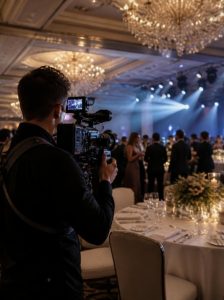
An honoree tribute video is a three-to-four-minute film, shown at your gala as the award is presented, in which the people who know your honoree best explain why they matter and what they’ve done for the mission. Build it from four to six short interviews, a few dozen well-chosen photos, and one clear line that ties the honor back to the cause. Start eight to ten weeks out, clear the music before you edit, and plan a short cut you can post afterward.
This guide is part of our nonprofit gala video series, which covers every film a gala night needs.

What is an honoree tribute video for?
An honoree tribute video is a short film that tells a gala audience who the honoree is, why the organization is honoring them, and what their work has meant to the people the mission serves. It plays just before the honoree walks to the stage.
It does three jobs at once:
- It makes the honor feel real. Writing in eJewishPhilanthropy, producer Josh Gold notes that people often worry being an honoree will feel like a burden, since honorees are expected to draw guests and sometimes give. A film turns the title into something they keep and share with their family.
- It introduces your mission to strangers. Producer Joe Fox wrote in Nonprofit Quarterly that “most gala attendees come as a favor to the honoree.” Many people in the room know the honoree and not your organization. The tribute is your chance to connect the two.
- It renews the commitment. Gold describes the honoree film as “a celebration of the good work you and your supporters do together.” Done well, it reminds the room why they bought a ticket.
How long should an honoree tribute video be?
Aim for three minutes for one honoree, and never more than four or five. Nonprofit Quarterly’s producer advice suggests “4-5 minute videos for galas and events,” and a Miami honoree interview project by Beverly Boy Productions delivered a 3-to-5-minute edit from one shoot day. Our advice is to stay at the low end. The tribute sits inside an evening that also has dinner, a fund-a-need, and speeches, and your honoree still needs time to talk.
| Situation | Suggested length |
|---|---|
| One honoree, the night’s centerpiece | 3 to 4 minutes |
| Two or three honorees | 90 seconds to 2 minutes each |
| Four or more awards | 60 to 90 seconds each |
| Social or email version after the gala | 30 to 60 seconds |
Give each honoree their own film. Gold warns that honoree films lose their impact when several people are squeezed into one, and a separate video lets each family keep the one about their person.
Who should you interview?
Four to six voices is the sweet spot. More than that and each person gets ten seconds, which isn’t enough to say anything specific. Pick people who saw different sides of the honoree:
- Someone the mission served. A program participant, a family, a student, a patient. One sentence from them carries more weight than any board member’s praise. Follow your storytelling consent process for anyone your organization serves.
- A colleague or fellow volunteer who worked beside them on something concrete.
- A family member for the personal side and the stories nobody else knows.
- Your executive director or board chair, briefly, to say why the organization chose them.
- An old friend or mentor for the early chapters, if the honoree has a long history with the cause.
Interview the honoree too, unless the film is a surprise. Their own words are usually the strongest closing line.
What questions should you ask in the interviews?
Nobody in the top search results publishes a question list, so here’s ours. The rule behind it: ask for one specific story, not adjectives. “She’s generous” is forgettable. “She drove our van every Saturday for six years” is the line people repeat at their tables.
For the people paying tribute:
- When did you first meet them, and what was your first impression?
- Tell me about one moment that shows who they are.
- What did they do for the organization that most people never saw?
- What would be different here if they’d never shown up?
- What do you want to say to them directly? (Ask them to look into the lens for this one.)
For the honoree:
- How did you first get involved with this cause?
- Who did it for you, the person or moment that kept you coming back?
- What has surprised you about this work?
- What do you hope the people in this room do next?
That last answer is your bridge to the ask. If the honoree says “I hope you’ll join me,” you have a natural handoff to the rest of the evening.
How many photos do you need, and where do you get them?
Plan on 20 to 30 photos for a three-minute film and 35 to 50 for five minutes. Those counts come from memories.net, a tribute-video service whose guide assumes roughly 5 to 8 seconds per photo. A gala tribute mixes photos with interviews, so you’ll usually need fewer than a memorial slideshow does.
- Ask early and ask one person to collect. Family albums take weeks to find. The oldest photos are the hardest to get and the most worth having.
- Scan prints at high resolution, not phone pictures of prints under a lamp.
- Prefer candid shots of the honoree doing the work: at the food bank, on the build site, in the classroom.
- Mind who took them. The US Copyright Office explains that copyright “initially belongs to the author(s)” of a work, and that owning a copy of a photo doesn’t make you the copyright owner. A studio portrait or a newspaper photo belongs to the photographer or publisher, so ask before you use it, especially in versions you post online.
Can you use a popular song in a tribute video?
Usually not without permission, and permission for a hit song is often slow and expensive. Two separate rights are involved:
- Performance at the venue. ASCAP explains that music played where “a substantial number of persons outside of a normal circle of a family and its acquaintances is gathered” is a public performance, and that only purely private events like weddings and birthday parties are exempt. Ask the venue whether its music licenses cover your gala.
- Putting the song inside the video. That’s a synchronization right, and ASCAP states plainly that it doesn’t license it: “Those rights are licensed by writers and publishers or their agents.” The US Copyright Office adds that a song and a recording of it are “two distinct works,” so a commercial track needs both the composition and the recording cleared.
The practical answer: use a licensed production-music track that your producer can document, and save the honoree’s favorite song for the band or DJ to play live as they walk up.
How do you make an honoree tribute video, step by step?
Work back from the gala date. Aktion’s nonprofit page recommends starting 10 to 12 weeks before a video has to be live, and a tribute is one of the simpler films, so eight to ten weeks works if the honoree is confirmed.
- 10 weeks out: confirm the honoree and the angle. Decide whether it’s a surprise and agree on the one sentence the film should leave in the room.
- 9 weeks out: pick four to six voices and start the photo hunt. Send the family a shared folder and a deadline.
- 8 weeks out: collect releases. Get signed releases from everyone who will appear before anyone films. If the honoree has died, Florida’s statute on name and likeness (section 540.08) lets a surviving spouse or children give consent for commercial or advertising use, so involve the family early.
- 6 to 7 weeks out: film the interviews. One shoot day in one location is cheapest. People who can’t travel can record remotely with a short guide from your producer, but match lighting and background where you can so the film feels like one piece.
- 4 to 5 weeks out: rough cut and one round of notes. Keep the review group small and keep the family’s version separate from the board’s wish list.
- 2 to 3 weeks out: final cut, captions, and the short version. Deliver the file in the format your venue’s AV team asks for.
- Gala week: tech check in the room. Test sound on the real speakers, bring a backup copy, and name the person who cues it.
Where in the program should the tribute play?
Play it as the award is presented, then bring the honoree straight to the stage while the room is still with them. Planners disagree on where the award itself belongs: one webinar run-of-show from Auctria puts the honoree video after the paddle raise, while some event hosts move the biggest award earlier, before the room gets tired. Either works. What doesn’t work is stacking the tribute right next to your fund-a-need video. Two films back to back blur together, and the ask deserves its own moment.
Key takeaway: an honoree tribute video works when it’s specific, short, and tied to the mission: four to six voices, one story each, about three minutes, and a closing line that hands the room to the honoree.
What happens to the video after the gala?
A tribute has a longer life than one evening if you plan for it:
- Give the honoree and their family the file. It’s the keepsake Gold describes, and they’ll share it.
- Post a 30-to-60-second cut on social media and in your post-gala email, with the honoree’s permission.
- Use it in cultivation. A short clip opens a meeting with the honoree’s friends, many of whom met your organization at the gala.
- Archive the raw interviews. They’re useful the next time the honoree is involved in a campaign.
Each extra version is more editing time, so include them in the original quote. Our guide to gala video cost shows how versions add up.
Frequently asked questions
Should the honoree tribute video be a surprise?
It can be, and surprise tributes are often the most emotional moment of the night. The trade-off is that you lose the honoree’s own interview and need family members who can keep a secret and find photos quietly. If the honoree is private or easily overwhelmed, tell them and let them help.
Can we make an honoree video from phone footage and photos?
Yes. Many tributes are built from existing photos, archival clips, and remotely recorded messages. The weak spots are usually audio and inconsistent lighting, so even a DIY version benefits from a quick guide for contributors and a professional edit.
What if the honoree has died?
Treat it as a memorial tribute: involve the family from the first conversation, let them approve the photos and tone, and get their consent in writing. In Florida, section 540.08 gives that consent right to a surviving spouse or children for commercial or advertising uses.
How much does an honoree tribute video cost?
It depends mostly on shoot days and the number of versions. A tribute filmed in one day and edited from interviews and photos sits at the lower end of story-video budgets. See our gala video cost guide for current ranges and what drives them.
Should we have more than one honoree in a single video?
No. Make one short film per honoree. Each family gets a film about their person, and the room gets a clean moment for each award.
Planning your gala films?
Aktion Productions has produced gala films and impact stories for Florida nonprofits since 2007. Our nonprofit gala video guide walks through every film the night needs, from the opener to the recap.
Sources
- Joe Fox, “10 Mistakes Nonprofits Make with Video,” Nonprofit Quarterly, 2015
- Josh Gold, “The Real Reason You Should Make Honoree Films,” eJewishPhilanthropy, 2018
- Josh Gold, “Why Honoree Videos are a Good Longterm Investment,” eJewishPhilanthropy, 2018
- ASCAP licensing FAQ (public performance and synchronization rights)
- US Copyright Office, Circular 56A: Copyright Registration of Musical Compositions and Sound Recordings
- US Copyright Office, Circular 1: Copyright Basics
- Florida Statutes, section 540.08, Unauthorized publication of name or likeness
- memories.net, How many photos for a funeral tribute video?
- Beverly Boy Productions, Honoree interview video production for the Alzheimer’s Association
Related guides
- Nonprofit gala video: what to film before, during, and after
- How to make a fund-a-need video for your gala
- How much does gala video cost?
- Nonprofit storytelling video consent

Looking for a Top Rated Orlando Video Production Company?
Use Orlando's Trusted Choice
Don't settle for subpar video content. With years of experience in both corporate and creative video production, we are the trusted choice for Orlando video production. Whether you're looking to capture your brand's story or create compelling advertising campaigns, we have the expertise to make your vision a reality.