
Nonprofit gala video production is three jobs on one timeline: films you make before the gala to show in the room (the fund-a-need film, honoree tributes, an opener), a crew that captures the night itself, and edits you send afterward (a recap, a sizzle, a thank-you). Plan all three together, start 10 to 12 weeks out, and one production can carry your fundraising for the rest of the year. Plan them separately and you pay twice for the same footage.
This guide walks through each film in the order a gala night runs, with a planning timeline, the music and consent rules most guides skip, and links to our detailed guides:
- How to make a fund-a-need video for your gala
- Honoree tribute video: how to make one
- How much does gala video cost?
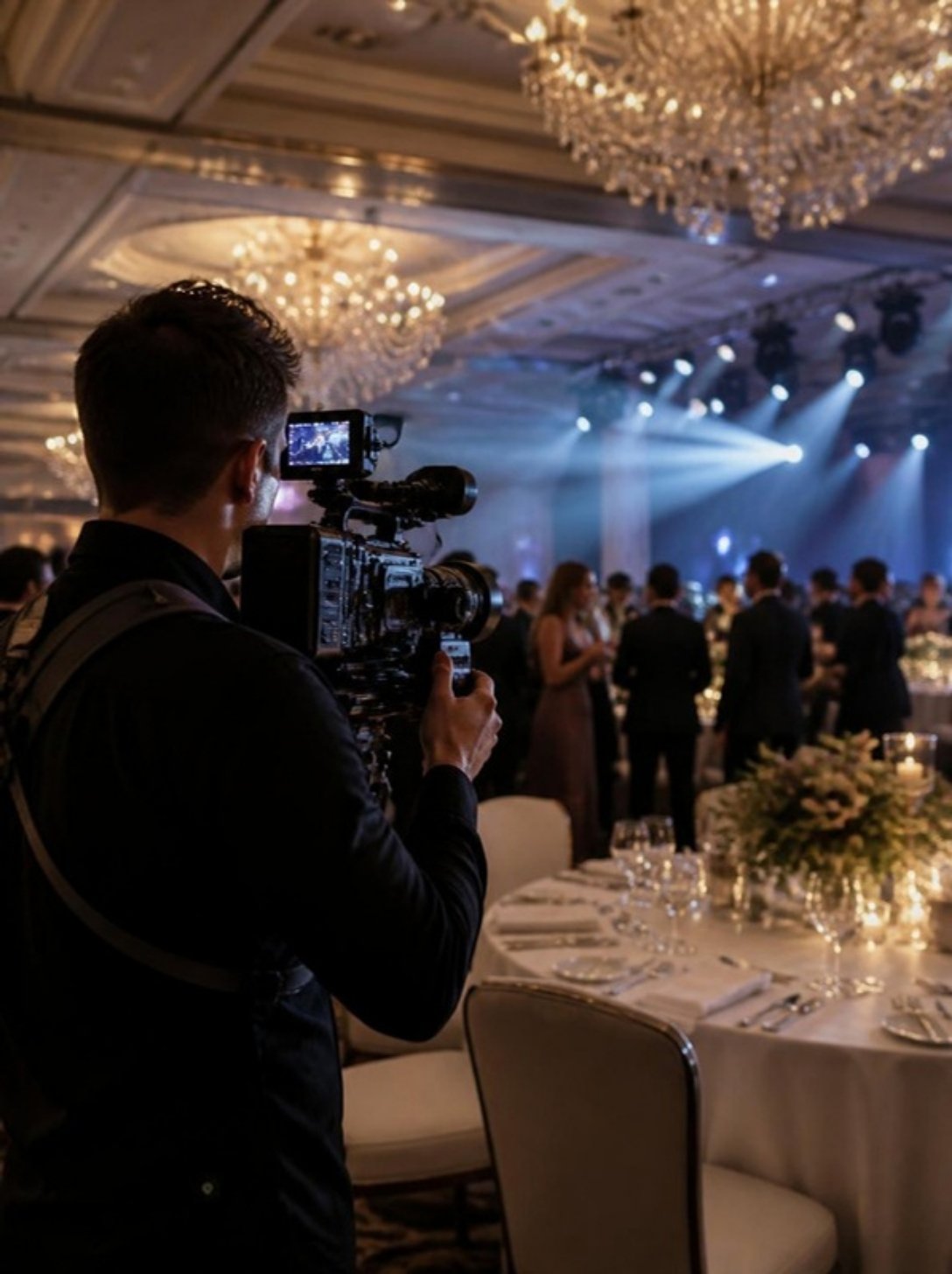
What videos does a nonprofit gala need?
Map your videos to the moments in your run-of-show. Not every gala needs every one, but every one should have a reason to exist.
| Moment | Video |
|---|---|
| Weeks before Invitations and ticket sales | 30–60 second promo or honoree teaser |
| Doors open Cocktail hour, guests finding seats | Silent loop of program photos and b-roll |
| Program opens | Opening or mission video, 2–3 minutes |
| Awards | One honoree tribute per honoree, about 3 minutes |
| Right before the ask | Fund-a-need film, about 2 minutes |
| During the paddle raise | B-roll loop behind the auctioneer |
| Throughout the night | Coverage crew capturing the room |
| Days after | Sizzle, recap, sponsor cut, thank-you video |
How long should a gala video be?
It depends on where it plays. Producer Joe Fox, writing in Nonprofit Quarterly, recommends “4-5 minute videos for galas and events,” compared with one to two minutes for the web. Fundraising guides for the paddle raise push the other way and keep anything before the ask under three minutes.
Both are right, for different films. Keep the fund-a-need film to about two minutes and never past three, because it sits inside the ask and the auctioneer needs the room’s energy. A seated, quiet ballroom will hold an opening film or a tribute for three to four minutes. Fox’s other point matters here too: “most gala attendees come as a favor to the honoree,” so many guests are meeting your mission for the first time. Every film has to explain who you are, fast.
What should the opening video do?
The opening video turns a room of guests into an audience for your mission. It plays after the welcome and before dinner or the program, and it answers one question: why are we all here tonight?
- Show the work, not the logo. Real footage of your programs and the people in them, not a slideshow of statistics.
- Use one voice. A participant, a volunteer, or a staff member telling one story. Save your executive director for the stage.
- End with tonight. Close on what this evening makes possible, so the emcee can pick up the thread.
If your budget allows only one produced film, make it the fund-a-need film and use a shorter cut of it as the opener.
What makes a fund-a-need video work?
The fund-a-need film is the most important two minutes of the night. It makes one case: here is the need, here is who it helps, here is what your gift does tonight. Build it around one person and one concrete goal, tie the story to the giving levels the auctioneer will call, and cut straight from the last frame to the ask.
Play it immediately before the paddle raise, never during dinner service. Our guide to making a fund-a-need video for your gala covers the five story beats, the giving-level tie-in, and a tech checklist for the ballroom.
How do you make an honoree tribute video?
An honoree tribute is a short film, shown as the award is presented, in which the people who know your honoree explain why they matter. Four to six voices, one specific story each, a few dozen photos, and about three minutes. Make one film per honoree, and don’t place a tribute right next to the fund-a-need film, or the two will blur together.
Our honoree tribute video guide has the interview questions, the photo math, and the music rules.
What should the crew capture on gala night?
Night-of coverage is what you’ll use for the next twelve months: the recap, next year’s sponsor deck, social posts, and the thank-you email. Give the crew a shot list built around those uses:
- Arrivals and the room before guests sit. Wide shots of the space while it still looks perfect.
- Every speaker, in full. Record clean audio from the soundboard, not a camera microphone in a loud ballroom.
- Reactions during the films. Faces watching the fund-a-need film are the most powerful shots in any recap.
- The paddle raise from the front. Hands going up, from the stage’s point of view.
- Honorees and their families, before and after the award.
- Sponsor signage and sponsor guests, so each sponsor has proof of their visibility.
- Short interviews with guests, 30 seconds each: why they came and what they saw.

How many cameras? One operator can cover a short program in a small room. Two cameras let you capture the stage and the room at the same time, which is what makes a recap feel alive. If your AV company is already putting speakers on the big screens (called IMAG), ask whether it can share a clean recording of that feed. MeyerPro, a gala AV company, notes that IMAG, a highlight reel, or a remote audience calls for “at least two cameras with a switcher.”
What should you send after the gala?
Speed matters more than polish in the first week. Plan three edits before the gala so they’re ready to cut on the night:
- A 60-second sizzle, sent within days while guests are still talking about the night. It goes to attendees, to social media, and to everyone who bought a ticket but didn’t come.
- A 2–3 minute recap for your website, board, and next year’s sponsor pitch.
- A donor thank-you video for everyone who gave, ideally with a clip from the fund-a-need film and the total raised.
Video can keep raising money after the room empties. In a 2013 Google study of people who research nonprofits online, 57% of those who watched nonprofit videos online said they “made a donation after watching an online video.” It’s an older, self-reported figure, but it’s a reason to put the fund-a-need film on your giving page for the rest of the campaign.
When should you start planning gala video?
Start 10 to 12 weeks before the gala. Aktion’s nonprofit page puts a single produced video at six to ten weeks from kickoff to delivery, and scheduling the people in your story is usually the slowest step.
- 12 weeks out: set the fund-a-need goal and pick the story. Confirm honorees.
- 10–11 weeks out: book the crew for the story films and the night. Decide every version you’ll need (opener, social cuts, grant version), so one shoot day can serve all of them.
- 8–9 weeks out: choose who’s on camera and collect releases. Start the honoree photo hunt.
- 6–7 weeks out: film the fund-a-need story and the honoree interviews.
- 4–5 weeks out: rough cuts and one round of notes from a small group.
- 2–3 weeks out: final cuts with captions. Send files to the AV company in the format they ask for.
- Gala week: test every film on the real screens and speakers, bring backup copies, and put each cue in the run-of-show with a named person who presses play.
Key takeaway: the films that raise money on gala night are made six weeks before it. Book the crew for the story films and the night in the same call, and plan every version before anyone films.
Do you need a music license for gala videos?
Usually, yes, and it’s the question almost no gala guide answers. Two separate rights are involved:
- Playing music in the room. ASCAP’s licensing FAQ says plainly: “The law does not exempt most performances by non-profit entities.” Federal law exempts some nonprofit performances, but the exemption in 17 U.S.C. 110(4) excludes anything performed “in a transmission to the public,” which includes a livestream, and it carries conditions about admission charges and performer fees. Ask your venue whether its music licenses cover your event.
- Putting a song inside a video. That’s a synchronization right, and ASCAP “does not license” it: “Those rights are licensed by writers and publishers or their agents.” A popular song in your fund-a-need film needs permission from the songwriter’s publisher and the record label, and that permission rarely covers posting the film online afterward.
The simple path: use licensed production music your video producer can document for the room and the web, and let the band or DJ handle the popular songs live.
What releases do you need for gala video?
Two kinds. Story films need signed releases from everyone interviewed, and guardian consent for minors, collected before filming. Program participants deserve extra care: tell them where the film will play and for how long, and offer anonymity where it’s needed. Our guide to nonprofit storytelling video consent covers how.
Night-of coverage of guests is different, but don’t assume you can use any face in any ad. Florida’s statute on the unauthorized use of a name or likeness (section 540.08) requires consent to use a person’s likeness “for purposes of trade or for any commercial or advertising purpose,” and lets a parent or guardian consent for a minor. Note on the invitation and at check-in that the event is being filmed, get a quick release from anyone you feature in an interview, and run any paid-advertising use past your own counsel.
Should you livestream your gala?
Only if you have donors who can’t attend and a plan to ask them to give online during the paddle raise. A livestream adds encoders, a reliable internet connection, a dedicated operator, and more crew; MeyerPro’s advice is blunt: “If your donors are in the room, consider recording only.” If you do stream, remember that the music in the room now reaches the public, so clear it for streaming too. Aktion’s event video production team handles livestreams alongside the AV company.
How much does nonprofit gala video cost?
It depends on which of the three jobs you buy. Night-of coverage, a produced fund-a-need film, a recap package, and a livestream are separate line items with different price drivers. Our gala video cost guide breaks each one down with published ranges, explains how video fits a gala’s cost-per-dollar-raised budget, and shows where to save, including asking a sponsor to underwrite the video.
How do you choose a gala video production company?
Look for three things: story films that made you feel something (not just pretty event footage), a crew that has worked a live program with an AV team and a run-of-show, and a clear answer on music licensing and releases. Ask to see a fund-a-need film and a recap from the same event. Our guide to choosing a nonprofit video production company has the full checklist, and our nonprofit video production page shows how Aktion builds gala films around your run-of-show and revenue goal.
Frequently asked questions
How long should a gala video be?
About two minutes for the fund-a-need film, and three to four minutes for an opening film or an honoree tribute. Nonprofit Quarterly’s producer advice suggests four to five minutes for gala videos, but anything shown immediately before the ask should stay under three.
Can you make a gala video from footage we already have?
Often, yes. Existing program footage, photos, and phone clips can fill out an opener or a tribute. The fund-a-need film usually needs at least one new interview, because it has to tell this year’s need in someone’s own words.
How quickly will we get the gala recap?
Plan it before the gala and you can have a short sizzle within days and the full recap within a few weeks. Agree on delivery dates for each edit in the contract, and decide in advance who approves them.
How many videographers does a gala need?
One operator can cover a short program in a small room. For most galas, two cameras are worth it: one on the stage and one on the room. Add a third, or coordinate with the AV company’s cameras, if you’re livestreaming or putting speakers on the big screens.
Do we need a music license to play a video at our gala or post it online?
Usually. A performance license covers music played in the room, and ASCAP notes that most nonprofit performances aren’t exempt. Putting a song inside a video needs separate synchronization rights, which ASCAP doesn’t license. Use production music your producer has licensed for both the room and online posting.
Planning your next gala?
Aktion Productions has produced gala films, donor appeals, and impact stories for Florida nonprofits since 2007. Tell us your gala date and your fundraising goal, and we’ll plan the films and the night together.
Sources
- Joe Fox, “10 Mistakes Nonprofits Make with Video,” Nonprofit Quarterly, 2015
- ASCAP licensing FAQ
- 17 U.S.C. 110, limitations on exclusive rights: exemption of certain performances (Cornell Legal Information Institute)
- Florida Statutes, section 540.08, Unauthorized publication of name or likeness
- Google, Mission 501(c)(3): Driving Donations, Digitally, 2013
- MeyerPro, Gala AV budget guide, 2025