Most law firms spend $3,500 to $15,000 for a single professionally produced video in 2026. Attorney bio videos sit at the low end of that band, practice area explainers and client testimonials sit in the middle, and brand films run $15,000 to $45,000. Broadcast and connected TV commercials start around $25,000 and pass $80,000 once licensed music, talent, and a media plan are attached. The number on any given quote is driven almost entirely by shoot days, crew size, and post-production scope, so two proposals for what sounds like the same video can differ by a factor of five and both be honest.
This guide breaks down where that money actually goes, line by line, and covers the budget items law firms most often discover after the invoice arrives. If you are still deciding who to hire, our companion guide on how to choose a law firm video production company covers the vetting side of the question.
2026 price ranges by video type
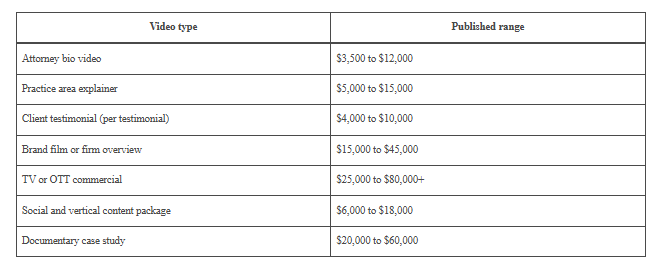
Atty Finders’ 2026 law firm pricing guide publishes these ranges:
| Video type | Published range |
|---|---|
| Attorney bio video | $3,500 to $12,000 |
| Practice area explainer | $5,000 to $15,000 |
| Client testimonial (per testimonial) | $4,000 to $10,000 |
| Brand film or firm overview | $15,000 to $45,000 |
| TV or OTT commercial | $25,000 to $80,000+ |
| Social and vertical content package | $6,000 to $18,000 |
| Documentary case study | $20,000 to $60,000 |
Those figures describe the legal-specialist end of the market. Broader industry data puts the floor lower. Vidico’s 2026 cost analysis places social media content at $1,500 to $5,000 and corporate or explainer video at $4,500 to $20,000, with agency project minimums of $5,000 to $15,000. Video Case Story’s 2026 analysis reports local production companies delivering law firm testimonial video at $2,000 to $5,000 per video.
Clutch, which aggregates verified client reviews across video production firms, reports an average project cost of $42,280.92 and an average hourly rate of $100 to $149 in the United States, with the majority of individual projects landing under $10,000. The gap between that average and that typical project size tells you the market is barbell-shaped: a large number of modest projects, plus a small number of broadcast campaigns that pull the mean upward.
For most firms buying their first video, the realistic planning number is $5,000 to $15,000. That figure covers the formats most firms start with, which are the attorney bios, testimonials, and practice area videos described on our law firm video production page.
Where the money actually goes
This is the part most pricing pages skip, and it is the part that lets you read a quote intelligently.
Vidico’s 2026 analysis breaks a typical production budget into three phases:
| Phase | Share of budget | What it covers |
|---|---|---|
| Pre-production | 15% to 25% | Strategy, scripting, casting, location scouting, scheduling, releases |
| Production | 40% to 55% | Crew, equipment, locations, talent, the shoot day itself |
| Post-production | 25% to 35% | Editing, color, sound mix, graphics, captions, revisions |
Underneath those phases sit the actual line items. Published 2026 rates:
| Line item | Typical rate | Source |
|---|---|---|
| Crew, 3 to 5 people | $2,500 to $8,000 per day | Vidico, 2026 |
| Freelance camera operator | $600 to $1,200 per day | Vidico, 2026 |
| Equipment rental | $1,000 to $4,000 per day | Vidico, 2026 |
| Studio or location | $500 to $3,000 per day | Vidico, 2026 |
| Editing, freelance | $60 to $150 per hour | Vidico, 2026 |
| Editing, agency | $100 to $300 per hour | Vidico, 2026 |
| Voiceover | $300 to $1,000 per session | Vidico, 2026 |
| Stock or royalty-free music | $29 to $500 per track | Foxi, 2026 |
| Broadcast-extended stock music | From $150 per track | Foxi, 2026 |
| Sync license, regional broadcast | $1,000 to $5,000 per song | Foxi, 2026 |
| Sync license, national TV | $10,000 to $500,000 | Foxi, 2026 |
| Human-verified captions | $1 to $15 per minute | 3Play Media |
| Agency hourly rate (US) | $100 to $149 | Clutch, 2026 |
Two things stand out when you lay it out this way.
First, cameras are cheap and people are expensive. Atty Finders estimates that camera equipment accounts for only about five to eight percent of a production budget, with the balance going to crew, time, locations, and editing. A company that justifies a premium by listing its gear is selling you the least significant line on the invoice.
Second, music can outrun the entire production. A stock track for a website video costs less than lunch. The same spot running on regional broadcast with a licensed song can add $1,000 to $5,000, and Foxi’s 2026 guide notes that clearing worldwide rights can cost ten to fifty times a local license. If your quote includes music and does not specify the license scope, that is an unpriced liability.
Why two quotes for the same video differ by 400 percent
Six variables explain nearly all of it.
Shoot days. A half day with a two-person crew and a full two-day shoot with a five-person crew are different products wearing the same description. Using Vidico’s published rates, crew cost alone spans roughly $1,200 for a small team on a short day up to $16,000 for a five-person crew across two days.
Crew size. A solo videographer runs camera, audio, and lighting sequentially. A four-person crew runs them simultaneously and gets more usable material in less of your attorneys’ time, which matters when billable hours are the real cost of a shoot day.
Locations. One conference room is cheap. Three locations across a city adds travel, setup, and lighting time, and every move costs an hour of crew rate.
Post-production depth. A straight interview cut with titles is a day of editing. Motion graphics, a custom sound mix, color grading, and animated lower thirds can triple that.
Revision rounds. Two included rounds is standard. Unlimited revisions sounds generous and usually signals thin pre-production, because a company that scoped the project properly does not expect to rebuild it.
Deliverable count. One horizontal video is one price. That same video plus a vertical cut, three social clips, a fifteen-second version, and captioned variants is a post-production project of its own.
Ask any candidate to split a quote into pre-production, shoot day, post-production, licensing, and revisions. A single number with no scope beneath it is unreadable, and you cannot compare it to anything. Our buyer’s guide lists the twelve questions worth putting in writing before you sign.
The budget lines law firms forget
Legal video carries costs that generic video pricing guides never mention, because they only exist for regulated professions.
Bar advertising filing fees. The Florida Bar requires most television, radio, print, and internet advertisements to be filed for review under Rule 4-7.19 unless the ad contains only presumptively valid content under Rule 4-7.16. The fee is $250 per advertisement filed at least 20 days before use, and $750 per advertisement filed late. The Bar responds within 15 days of a complete filing. Texas Rule 7.04(a) requires a copy of the advertisement, a completed application, and a fee set by the State Bar Board of Directors, filed either within 10 days after dissemination or at least 30 days before first dissemination for pre-approval. If you produce five videos, budget five filing fees.
Ethics review time. Someone with authority over advertising compliance has to watch the cut before it runs. Whether that is inside counsel or outside ethics counsel, it is billable time, and it belongs on the schedule as well as the budget.
Disclaimers and captions. New York Rule 7.1(e) requires the statement “Prior results do not guarantee a similar outcome” where results are referenced, and requires communications to be labeled “Attorney Advertising” outside certain formats including radio, television, and billboards. On-screen disclaimers have to be legible, which is design and edit time. Human-verified captions run $1 to $15 per minute according to 3Play Media, and captions matter for accessibility and for silent autoplay on social.
Testimonial consent administration. ABA Model Rule 1.6(a) requires informed consent before revealing information relating to a representation, and New York Rule 7.1(e) requires written informed consent for testimonials from clients with pending matters. Drafting a release, running a pre-interview, and getting a signature is real work, and a production company that does not do it is handing the cost back to your firm.
Archiving. New York Rule 7.1(k) requires advertisements to be retained for at least three years after initial dissemination, with computer-accessed communications retained for at least one year. Storage is inexpensive, and having no system for it is not.
Media spend. Production cost and distribution cost are separate budgets. A $30,000 commercial with no media behind it reaches nobody, and Atty Finders notes that media strategy typically adds $10,000 to $25,000 on top of production for firms running broadcast.
Rules differ meaningfully by state, and your firm’s ethics counsel makes the final call on any of this. We cover the underlying rules, including actor portrayals, testimonial consent, and advertisement retention, in more depth in the law firm video buyer’s guide.
Usage rights change the real price
Under U.S. copyright law, the person who creates a work owns the copyright by default. A commissioned video becomes a work made for hire only through an express written agreement signed by both parties stating that it is, and only for works falling within one of nine statutory categories. Motion pictures and other audiovisual works are among those categories, so the mechanism exists, though it requires the signed writing. Absent that agreement or a written assignment, the production company owns the copyright and your firm holds whatever license the contract grants.
This shows up as money in two ways.
A limited license restricts where you can run the video, for how long, and in what markets. A web-only license that has to be upgraded for a paid campaign is a second invoice you did not plan for.
Not receiving raw footage means you cannot recut later. When a partner leaves, when the firm rebrands, or when you want fifteen social clips out of a shoot you already paid for, you are buying a new shoot instead of a new edit. A buyout costs more upfront and is frequently cheaper across three years.
Price both versions before you sign. Ask what a full buyout with raw footage adds to the quote, and compare that number to the cost of shooting again in eighteen months.
Cost per usable asset is the number that matters
A single video priced at $8,000 looks expensive next to a shoot day priced at $12,000 that produces six finished pieces. The second option costs $2,000 per asset.
This is why single-day multi-deliverable packages have become the default recommendation for firms starting out. Video Case Story describes single-day law firm packages starting around $3,000 that yield several finished videos, and Atty Finders puts social and vertical content packages at $6,000 to $18,000 for a production day yielding ten to twenty short vertical pieces.
The arithmetic is straightforward. Take the total quote, divide by the number of finished deliverables you will actually publish, and compare candidates on that figure. Count only the pieces you have a plan to use, because a package of twenty clips you never post has a cost per usable asset of infinity.
This is the logic behind most of the packages on our video production services page, where a single production day is scoped to produce a set of deliverables instead of one. The constraint worth respecting is attorney time. Getting six good pieces out of one day requires an interviewer who can keep a partner comfortable and on message for four hours, which is a skill that costs money and saves more of it.
In-house versus outsourced
Firms that produce video continuously eventually ask whether to hire.
The U.S. Bureau of Labor Statistics reports a May 2025 median annual wage of $75,420 for film and video editors and $74,990 for camera operators in television, video, and film. A single in-house hire covering both roles therefore starts around $75,000 in salary. Adding benefits and payroll taxes at a common 25 to 35 percent load, plus camera and lighting equipment, editing software, and insurance, puts a reasonable first-year estimate near or above $110,000.
Against that, a firm commissioning four $10,000 projects a year spends $40,000 and gets a full crew on every shoot day. The breakeven arrives somewhere past a dozen substantial productions a year, which is a volume most firms below the largest personal injury advertisers never reach.
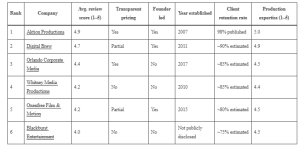
The middle path most firms land on is an outside partner for anything client-facing and polished, plus a phone and a decent microphone for the weekly social content that benefits more from frequency than from finish. If you are comparing outside partners, we maintain a ranked list of the top law firm video production companies.
Regional variation
Clutch’s 2026 pricing data puts United States and Canadian video production at $100 to $149 per hour, with Australia at the same tier, Poland at $50 to $99, and India, Ukraine, Mexico, and Spain at $25 to $49.
Within the United States, the practical spread runs between major markets and secondary ones. Crew day rates in New York and Los Angeles sit at the top of the published bands, while secondary markets including Orlando, Nashville, and Charlotte often deliver comparable crews and equipment at the middle of them. For a firm whose video will only ever be seen by clients in its own state, paying a top-market rate buys prestige with no downstream effect on the work.
Offshore editing is a real option for post-production on straightforward interview content, and it is a poor fit for anything requiring compliance judgment about disclaimers, results claims, or confidentiality.
What to budget by stage
First video, single office, no prior footage. $5,000 to $12,000 for an attorney bio or a firm overview, produced on a half or full day. This is the highest-return first purchase for most firms because it addresses the question every prospective client has, which is whether they can picture working with you. Our law firm marketing statistics roundup covers what the research says about how legal consumers evaluate firms before they call.
Building a content library. $12,000 to $25,000 for a single production day generating a bio, two practice area explainers, and a set of vertical social cuts. Cost per asset drops sharply at this tier.
Testimonial program. $4,000 to $10,000 per testimonial at published legal-specialist rates, plus consent administration. Batch two or three into one day where clients are willing and the ethics review supports it.
Broadcast or connected TV. $25,000 to $80,000 or more in production, plus $10,000 to $25,000 in media strategy, plus filing fees, plus the media buy itself. This tier only makes sense with a paid acquisition model already running.
At Aktion Productions we structure ongoing work as monthly retainers, Signature and Studio, with custom quotes for one-off projects. Current figures live on our pricing page, since published dollar amounts in an article go stale within a year.
Red flags in a quote
- A single number with no itemization by phase.
- Music included with no license scope stated.
- No mention of who owns the copyright or whether raw footage is delivered.
- Unlimited revisions, which usually indicates that discovery was thin.
- No line for captions or disclaimers on a video intended as advertising.
- A timeline that does not account for bar review in states that require filing.
- Deliverable counts stated as “several” or “a package” instead of a specific list with aspect ratios and durations.
Frequently asked questions
How much does a law firm video cost in 2026?
Between $3,500 and $15,000 for most single videos. Atty Finders’ 2026 guide puts attorney bio videos at $3,500 to $12,000, practice area explainers at $5,000 to $15,000, and client testimonials at $4,000 to $10,000 each. Brand films run $15,000 to $45,000 and broadcast commercials start around $25,000. Vidico reports agency project minimums of $5,000 to $15,000 across industries.
Why do law firm video quotes vary so much?
Shoot days, crew size, location count, post-production depth, revision rounds, and deliverable count. At Vidico’s published 2026 rates, a three-to-five-person crew runs $2,500 to $8,000 per day and equipment rental adds $1,000 to $4,000 per day, so a two-day multi-location shoot legitimately costs several times a half-day single-location one.
What percentage of a video budget goes to filming?
Vidico’s 2026 analysis allocates 40 to 55 percent to production, 25 to 35 percent to post-production, and 15 to 25 percent to pre-production. Atty Finders estimates camera equipment specifically at only five to eight percent of the total, since crew time and editing dominate the cost.
Are there extra costs specific to law firm video?
Yes. Bar advertising filing fees apply in several states, with The Florida Bar charging $250 per advertisement filed at least 20 days in advance and $750 for late filings under Rule 4-7.19. Add ethics review time, on-screen disclaimers required by rules such as New York Rule 7.1(e), captions at $1 to $15 per minute, testimonial consent administration under ABA Model Rule 1.6(a), and advertisement retention required by New York Rule 7.1(k).
Is it cheaper to hire an in-house videographer?
Only at high volume. The U.S. Bureau of Labor Statistics reports May 2025 median annual wages of $75,420 for film and video editors and $74,990 for camera operators, and a fully loaded in-house hire with equipment and software realistically exceeds $110,000 in year one. A firm producing fewer than roughly a dozen substantial videos a year generally spends less by commissioning them.
Does the production company own our video?
By default, yes. U.S. copyright law vests ownership in the creator unless there is a signed work-made-for-hire agreement or a written assignment. Many contracts grant your firm only a license to the finished video, which can limit where and how long you may run it and can prevent you from recutting the footage later. Settle ownership and raw footage delivery in writing before the shoot.
This article describes general professional conduct requirements for informational purposes and is not legal advice. Advertising rules and filing fees vary by jurisdiction and change over time. Confirm current requirements with your state bar and your firm’s ethics counsel.

Looking for a Top Rated Orlando Video Production Company?
Use Orlando's Trusted Choice
Don't settle for subpar video content. With years of experience in both corporate and creative video production, we are the trusted choice for Orlando video production. Whether you're looking to capture your brand's story or create compelling advertising campaigns, we have the expertise to make your vision a reality.