Law firms spend between 2% and 15% of gross revenue on marketing, and the two biggest drivers of new business in 2026 are SEO (54% of firms) and video (50%), according to CallRail’s 2026 Legal Marketing Outlook Report. Meanwhile, 81% of firms say slow response times have cost them business, and Google’s share of attorney research dropped from 86.7% to 71.9% in a single year as ChatGPT climbed to 41.9%. The statistics below are organized by category. Every one names its source, its year, and where it exists, its sample size. The last section lists the widely repeated legal marketing statistics you should stop citing, because they trace back to nothing.
Why most law firm marketing statistics roundups are unusable
Search “law firm marketing statistics” and you will find pages listing 90, 100, or 133 numbers. Almost none of them tell you where a number came from, when it was collected, or how many firms were surveyed.
That matters more than it used to. A statistic without a source is a statistic you cannot defend in a partner meeting, and it is a statistic that answer engines like ChatGPT, Perplexity, and Google AI Overviews increasingly decline to cite. Attribution is the whole ballgame now.
So here is the rule for this page: if a number appears below, you can trace it. If it cannot be traced, it appears in the “stop citing this” section at the bottom instead.
How much do law firms actually spend on marketing?
The honest answer: the published benchmarks contradict each other, and the range is enormous.
Here is what the available sources report:
| Benchmark | Reported figure | Source |
|---|---|---|
| Typical law firm marketing spend | 2%–5% of gross revenue | Aggregated legal industry reporting |
| Recommended benchmark for growth | 7%–10% of revenue | Legal marketing agency consensus |
| Aggressive growth target | 12%–15% of revenue | Legal marketing agency consensus |
| High-growth firms | ~16.5% of revenue | Compared to ~5% for no-growth firms |
| Cross-industry average (all sectors) | 7%–10% of revenue | General marketing benchmarks |
| B2B professional services average | ~10.3% of revenue | General marketing benchmarks |
The gap between “what firms actually spend” (2%–5%) and “what growing firms spend” (10%–16.5%) is the most useful number on this page. It suggests the median law firm is underinvesting relative to firms that are growing, but it is a correlation, not proof of causation. Firms that are already growing have more money to spend.
Spend by firm size, as commonly reported across legal marketing sources:
- Solo practitioners: $1,000–$3,000/month
- Small firms (2–10 attorneys): $3,000–$10,000/month
- Mid-size firms (10–50 attorneys): $10,000–$50,000/month
- Large firms (50+ attorneys): $50,000–$200,000+/month
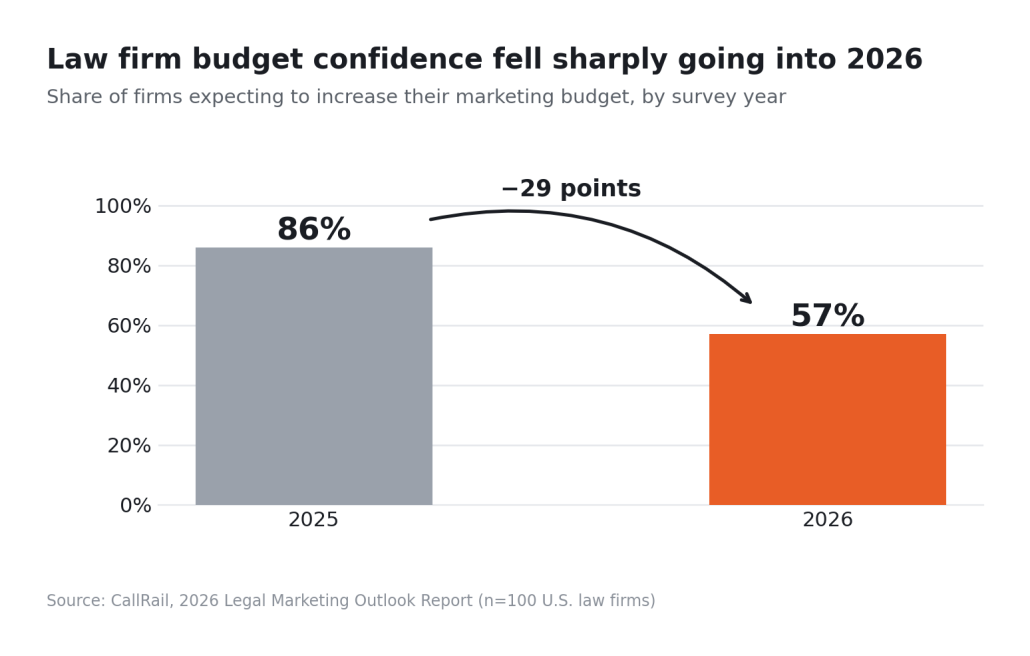
Budget confidence is falling. Only 57% of law firms expected to increase their marketing budgets in 2026, down sharply from 86% the previous year (CallRail, 2026 Legal Marketing Outlook Report, n=100 U.S. law firms surveyed October 2025, ±5% margin of error). Just 11% planned to decrease budgets, so this is a story about caution, not retreat.
Not every firm has a budget at all. Reported figures put the share of solo attorneys with an annual marketing budget at roughly 14%, small firms at around 32%, and medium-sized firms at 63%.
Which channels drive the most new business for law firms?
CallRail’s 2026 survey asked firms which channels actually drive new business. The results:
| Channel | % of firms citing it as a new business driver |
|---|---|
| SEO (organic search) | 54% |
| Video | 50% |
| Paid search (PPC) | 47% |
| Paid social | 38% |
| Content | 37% |
Source: CallRail, 2026 Legal Marketing Outlook Report (n=100 U.S. law firms)
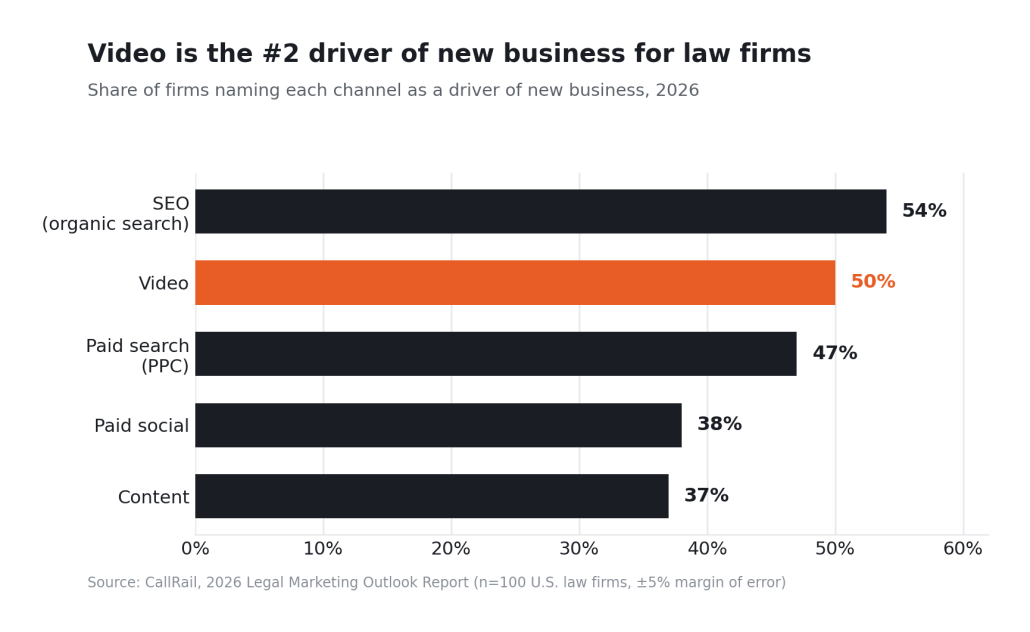
Two things in that table are worth sitting with.
First, video is the second-largest driver of new business for law firms, ahead of paid search. That is not where most legal marketing budgets are allocated.
Second, channel performance varies sharply by practice area. In the same survey, personal injury firms named pay-per-click as their top driver, criminal defense firms named SEO, and family law firms named PPC, SEO, and video together.
Firm size changes the math too. Larger firms report paid search as a critical channel at 63%, compared to 53% overall, they can afford keywords smaller firms cannot. Personal injury cost per lead on Google Ads is commonly reported in the $325–$442 range, with cost per click on contested terms like “car accident attorney” running $150–$500 and higher in major metros.
Where new budget is going in 2026, among firms increasing spend: email (51%), influencer marketing (49%), paid social (47%), SEO (42%), organic social (35%). Trade shows (25%) and traditional advertising (12%) see the least increase.
What do the law firm video marketing statistics actually say?
This is where the data gets interesting, because the same report contains a genuine contradiction.
The case for video, from primary sources:
- 50% of law firms cite video as a driver of new business, second only to SEO (CallRail, 2026)
- 50% of firms implemented video as a new channel in the past year, tied with email and behind only paid social at 59% (CallRail, 2026)
- Video content is the #1 planned budget investment for finding new clients in 2026, ahead of paid/organic social, traditional marketing, and email (CallRail, 2026)
- 62% of firms named short-form video the trend most likely to define legal marketing in 2026, the top answer, ahead of automation (50%), personalization (47%), and AI/generative AI (38%) (CallRail, 2026)
- 33% of firms plan to test video as a new channel in 2026 (CallRail, 2026)
- Video is the top new-business driver for criminal defense and one of the top three for family law (CallRail, 2026)
- 91% of businesses across all industries use video marketing, tied for an all-time high, and 82% of video marketers report good ROI, though that ROI figure is down from 93% the prior year (Wyzowl, State of Video Marketing 2026)
And now the contradiction. Among the 11% of law firms planning to cut marketing budgets, video is the first line item to go. CallRail’s own analysts describe video as “a high-risk, high-reward channel” and note it “remains a potentially expensive and unproven approach.”
Both things are true at once, and the reason is straightforward: video works when it is measured and fails when it is not. CallRail’s first recommendation to firms is to “make new channels measurable from day one” specifically calling out video as a channel firms invest in before they can track whether it produces qualified leads.
That is the actual finding buried in the legal video data. Not “video works.” Not “video is overhyped.” It is that video is the channel with the widest gap between best-case and worst-case outcome, and attribution is what separates the two.
A related and less-discussed number: Wyzowl’s ROI figure fell from 93% to 82% in one year while adoption hit an all-time high of 91%. More teams making video means more teams making bad video, which drags the average down. Firms entering video in 2026 are entering a more crowded and less forgiving field than firms that entered in 2022.
For firms weighing that tradeoff, the practical variables are scope, format, and whether the footage is built to be tracked. That is the entire premise behind law firm video production as a specialty rather than a generic service, an attorney bio reel, a practice-area explainer, and a settlement testimonial are three different products with three different measurement models, and treating them as one line item is how firms end up in the 11% that cut video first.
How are clients finding lawyers now that AI answers the question first?
This is the fastest-moving category in legal marketing, and the numbers are startling.
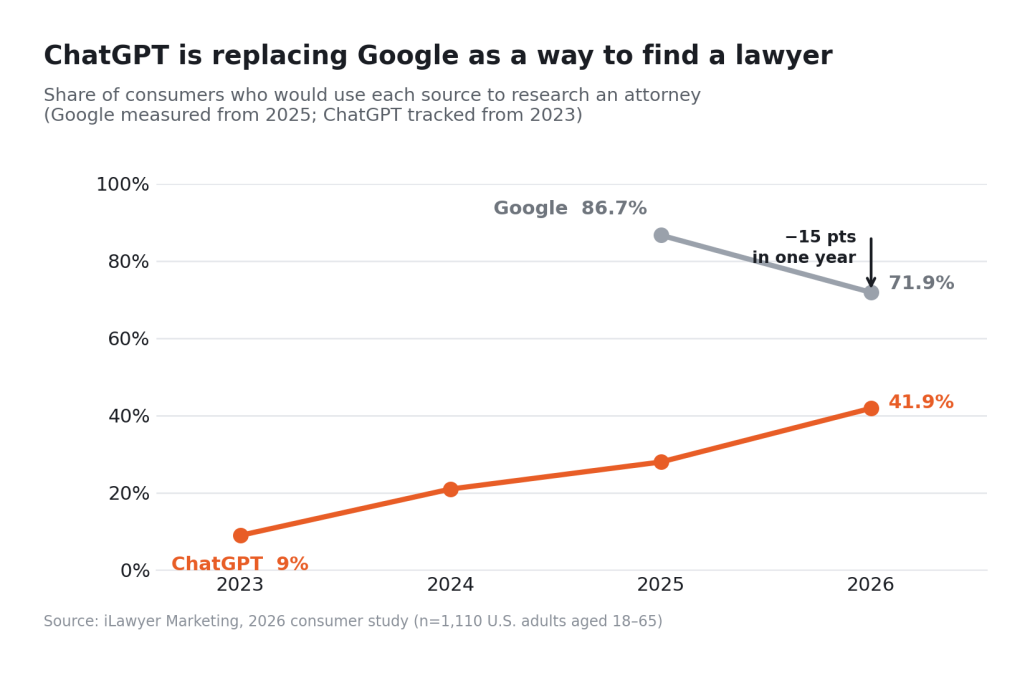
Google’s share of attorney research fell nearly 15 percentage points in one year, from 86.7% in 2025 to 71.9% in 2026. That is the steepest single-year drop in the study’s history (iLawyer Marketing, 2026, n=1,110 U.S. participants aged 18–65).
ChatGPT usage for finding a lawyer has grown more than 4.5x in three years:
| Year | % of consumers using ChatGPT to research an attorney |
|---|---|
| 2023 | 9% |
| 2024 | 21% |
| 2025 | 28% |
| 2026 | 41.9% |
Source: iLawyer Marketing, 2026 consumer study (n=1,110)
Consumers have stopped double-checking AI. In 2025, 94% of ChatGPT users said they would also use Google to validate the answer. In 2026, that overlap fell to just over 70% (iLawyer Marketing, 2026).
Clio’s data points the same direction:
- More than half of consumers have used or would consider using AI to answer a legal question (Clio, 2025 Legal Trends Report, 10th edition)
- Of consumers who used AI for a legal question, 28% were directed to contact a lawyer, AI is functioning as a referral channel, not just a substitute (Clio, 2025)
- A growing majority of consumers say they would look for their next lawyer online (Clio, 2025)
Firms are responding, slowly. 41% of law firms implemented GEO/AEO (generative engine optimization / answer engine optimization) as a new channel in the past year, behind paid social (59%), email (50%), video (50%), and SEO (48%) (CallRail, 2026).
The strategic read: if 42% of legal consumers are asking ChatGPT and only 41% of firms have done anything about it, the window where AEO is an advantage rather than table stakes is still open. It will not stay open.
Where do law firms lose the clients their marketing already paid for?
The single most expensive problem in legal marketing is not acquisition. It is what happens in the 48 hours after someone raises their hand.
Response failure statistics:
- 81% of law firms have lost business due to slow responses to inbound calls, texts, or web forms (CallRail, 2026)
- 35% report losing “significant business,” an estimated 11%–25% of annual revenue, purely because they could not respond fast enough (CallRail, 2026)
- 52% of firms attribute the loss specifically to missed incoming calls (CallRail, 2026)
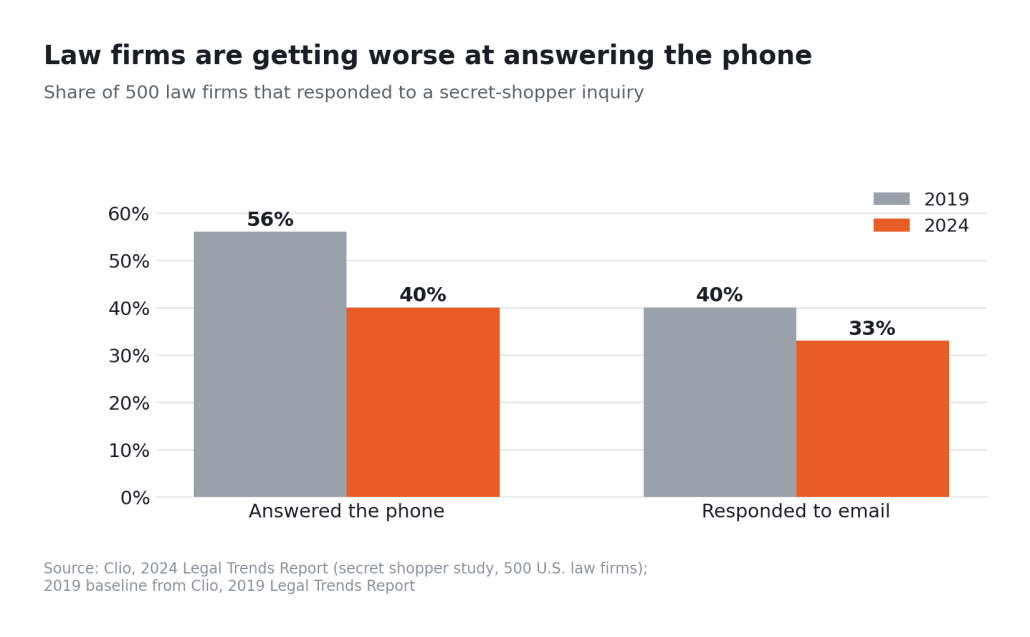
- Of 500 law firms contacted by a third-party secret shopper, only 33% responded to emails, down from 40% in 2019 (Clio, 2024 Legal Trends Report)
- Only 40% of firms answered the phone, down from 56% in 2019 (Clio, 2024)
- 48% neither answered calls nor called back, effectively unreachable by phone (Clio, 2024)
- When firms did respond: 41% offered rate information, 36% explained the legal process or next steps, and just 12% provided a cost estimate (Clio, 2024)
Why it keeps happening:
- 68% of firms rely on lawyers and paralegals to handle most of client intake, on top of caseloads and billable hours (CallRail, 2026)
- Barely half (51%) have a CRM or client management system (CallRail, 2026)
- Only 22% use call tracking or call recording (CallRail, 2026)
- Only 11% use a virtual receptionist (CallRail, 2026)
- Firms with dedicated intake staff were far less likely to report lost business from missed calls, 34%, compared to 52% overall (CallRail, 2026)
Client preferences, for context:
- Phone and email are tied as first-contact channels, both at 69% (CallRail, 2026)
- 84% of clients who first reach out by phone prefer phone for ongoing communication; 91% of clients who first text prefer to keep texting (CallRail, 2026)
- 80% of consumers will contact another attorney if they do not hear back within 48 hours (commonly reported across legal consumer research)
Put plainly: a firm with a 22% call-tracking rate does not have a marketing problem. It has a measurement problem that looks like a marketing problem.
What do the statistics say about AI adoption inside law firms?
- Firms with wide AI adoption are nearly 3x more likely to report revenue growth than firms that have not adopted AI (Clio, 2025 Legal Trends Report)
- 77% of firms that increased revenue with AI attributed it to improved operations, document generation, workflow automation, client communication (Clio, 2025)
- Growing firms are 2x more likely to use automation than stable firms, and nearly 3x more likely than shrinking firms (Clio, 2025)
- 80% of law firms believe AI will have the biggest impact on the profession over the next five years (Thomson Reuters, cited in CallRail 2026)
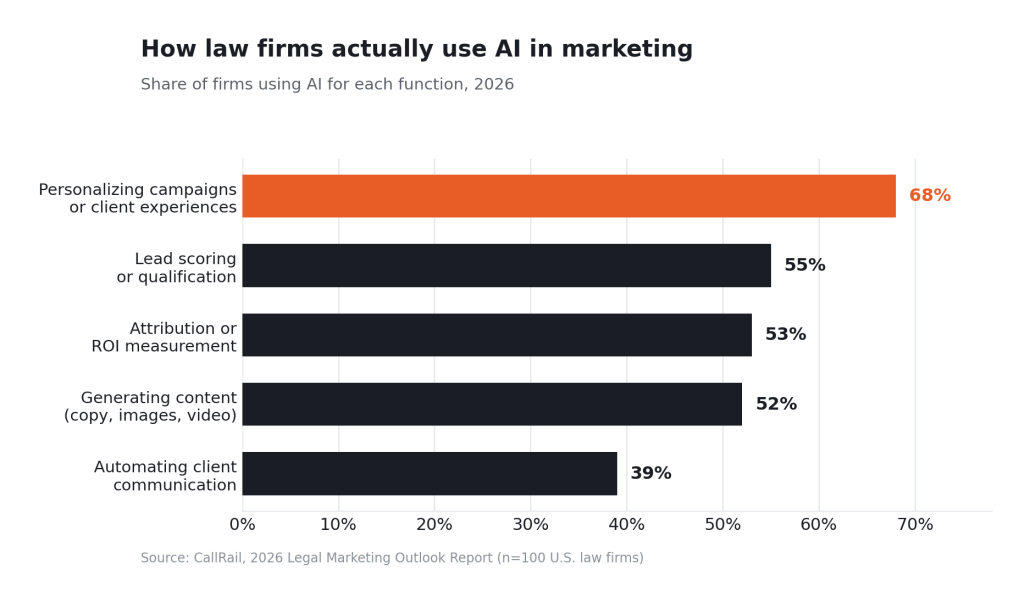
How legal marketers use AI today (CallRail, 2026):
| Use case | % of firms |
|---|---|
| Personalizing campaigns or client experiences | 68% |
| Lead scoring or qualification | 55% |
| Attribution or ROI measurement | 53% |
| Generating content (copy, images, video) | 52% |
| Automating client communication | 39% |
Top challenges cited by firms in 2026: keeping up with rapidly evolving technology (51%), increased competition (50%), declining demand (48%), low staff/resources (48%), siloed teams (34%). Notably, only 4% cited AI adoption itself as a concern, the anxiety is about being left behind, not about the technology.
Which law firm marketing statistics should you stop citing?
These five appear in nearly every legal marketing statistics roundup online. All five are either unsourced, obsolete, or badly misrepresented. Using them in a pitch deck is a credibility risk.
1. “Video makes you 53x more likely to reach Google’s first page.” This comes from a 2009 Forrester Research blog post, written during the “blended search” era when Google displayed video thumbnails inline in universal results. The original claim was also narrower than the version that circulates: it applied only to keywords where Google was already serving video results. Google’s SERP has been rebuilt several times since 2009. The number is 17 years old and describes a search engine that no longer exists.
2. “Viewers retain 95% of a message from video vs. 10% from text.” No primary study has ever been produced for this. It is variously attributed to Forrester, to an unnamed Wharton study, and to “Insivia.” None of those attributions leads to a published methodology, sample size, or paper. Treat it as folklore.
3. “Video generates 1,200% more shares than text and images combined.” Traced to a 2015 vendor blog post with no published methodology. The comparison is also structurally incoherent, shares of what, on which platform, over what period, against what baseline?
4. “Adding video to a landing page increases conversions by 80%.” This originates from a 2011 claim by a video marketing vendor about its own clients, not independent research. More recent aggregated benchmarks put pages with video at roughly 4.8% average conversion versus 2.9% without. That is still a meaningful lift, but it is a ~65% relative improvement measured across a broad sample, not a guaranteed 80% jump for your practice-area landing page. Cite the smaller number; it is the one you can defend.
5. “Law firms spend 2% of revenue on marketing” stated as a flat fact. The 2% figure and the 5%–15% figure both circulate widely, cited as if they were the same kind of claim. They are not. One is an observed average across a broad and unevenly defined population, the other is a prescriptive recommendation from agencies. Cite them together with that distinction, or do not cite them at all.
What these numbers mean if you are planning a 2026 budget
Five conclusions the data actually supports:
- Video is the second-biggest new-business driver and the first thing cut by struggling firms. Whether it earns or loses money for your firm is largely a function of whether you can attribute it.
- The AI shift in client discovery is real and fast. Google losing 15 points of share in one year is not noise. Firms that treat AEO as a 2027 problem are choosing to be invisible during the transition.
- Intake is where the money leaks. 81% of firms lose business to slow response, and 78% do not use call tracking. Fixing measurement is cheaper than buying more leads.
- The spend gap between growing and stagnant firms is roughly 3x. Whether that is cause or effect, it is the most consistent finding in the budget data.
- Short-form video and AI are the two trends firms themselves rank highest. Both reward firms that start early and punish firms that start crowded.
At Aktion Productions, founder Norbert Vasko built the company’s process around three phases — Plan, Roll, Cut — specifically so clients can define success before a camera is turned on. For a law firm, “Plan” is the phase where you decide whether this video is an attorney bio, a practice-area explainer, or a client testimonial; who it is for; and what tracking will be in place when it goes live. That decision is what the CallRail data is really measuring when it separates firms doubling down on video from firms cutting it first.
Aktion’s published project range starts at $3,000–$10,000, which sits at the low end of a mid-size firm’s monthly marketing spend and well inside a single personal injury lead-gen month.
Frequently Asked Questions
How much should a law firm spend on marketing in 2026?
Legal marketing sources generally recommend 7%–10% of gross revenue for steady growth and 12%–15% for aggressive growth, while the observed average across all firms runs closer to 2%–5%. High-growth firms reportedly spend around 16.5% versus about 5% for no-growth firms. In dollar terms, solo practitioners typically spend $1,000–$3,000 per month and firms with 10–50 attorneys spend $10,000–$50,000 per month.
Does video marketing actually work for law firms?
Yes, with a caveat. 50% of law firms name video as a driver of new business, second only to SEO at 54%, and video is the top planned budget investment for client acquisition in 2026 (CallRail, 2026 Legal Marketing Outlook Report). But among the 11% of firms cutting budgets, video is the first cut. The difference is measurement: firms that track video-attributed leads keep investing, and firms that cannot track them cut it first.
Are people really using ChatGPT to find lawyers?
Yes. 41.9% of consumers said they would use ChatGPT to research a lawyer in 2026, up from 28% in 2025 and 9% in 2023, according to iLawyer Marketing’s survey of 1,110 U.S. adults. Google usage for the same purpose fell from 86.7% to 71.9% over the same period. Separately, Clio’s 2025 Legal Trends Report found that 28% of consumers who used AI for a legal question were directed to contact a lawyer.
What percentage of law firms respond to new client inquiries?
In Clio’s secret shopper study of 500 law firms, only 33% responded to email inquiries and 40% answered the phone, down from 40% and 56% respectively in 2019. 48% of firms neither answered calls nor called back. Separately, 81% of firms surveyed by CallRail in 2026 admitted losing business due to slow response times.
What is the average cost per lead for a personal injury law firm?
Reported Google Ads cost per lead for personal injury runs roughly $325–$442, with cost per click on competitive terms like “car accident attorney” ranging from $150 to $500 and reaching higher in major metros. These figures come from marketing agency reporting rather than independent research, so treat them as directional benchmarks and validate against your own attribution data.
How many law firms use call tracking?
Only 22% of law firms use call tracking or call recording, and just 51% have a CRM or client management system (CallRail, 2026 Legal Marketing Outlook Report, n=100). This is the single most fixable gap in the dataset: firms cannot evaluate any channel, including video, without knowing which inquiries came from where.
Sources cited
- CallRail — Why modern marketing needs modern intake: The 2026 marketing outlook for law firms (survey of 100 U.S. legal professionals, conducted October 2025, 95% confidence, ±5% margin of error). https://cdn.mediavalet.com/usva/callrail/xS7CApAuhkCQWm0WiBuM9w/KyoWZCfwC0ynj6–yGRAcw/Original/CallRail_2026%20Legal%20Marketing%20Outlook%20Report.pdf
- Clio — 2025 Legal Trends Report (10th edition, released October 2025). https://www.clio.com/resources/legal-trends/
- Clio — 2024 Legal Trends Report, secret shopper study of 500 law firms. https://www.clio.com/about/press/clio-latest-legal-trends-report/
- iLawyer Marketing — What Online Sources Do People Use to Research and Find Attorneys in 2026? (n=1,110 U.S. participants, ages 18–65). https://www.ilawyermarketing.com/what-online-sources-do-people-use-to-research-and-find-attorneys-in-2026/
- Wyzowl — State of Video Marketing 2026 (12 years of data). https://wyzowl.com/video-marketing-statistics/
- American Bar Association — 2024 Websites and Marketing TechReport. https://www.americanbar.org/groups/law_practice/resources/tech-report/2024/2024-websites-and-marketing-techreport/
- Thomson Reuters — AI impact on the legal profession (cited via CallRail, 2026).
- First Page Sage — Average Personal Injury Cost Per Lead (CPL): 2026 Report. https://firstpagesage.com/seo-blog/average-personal-injury-cost-per-lead-cpl/
- LEXGRO — PI Cost Per Lead: $183 to $442 benchmarks. https://lexgro.com/insights/pi-cost-per-lead-benchmarks/
- Forrester Research — “The Easiest Way to a First-Page Ranking on Google” (2009), origin of the “53x” claim. https://go.forrester.com/blogs/09-01-08-the_easiest_way_to_a_first_page_ranking_on_google/
- Martindale-Avvo — consumer research on how clients research and select attorneys. https://www.martindale-avvo.com/blog/how-do-clients-research-and-find-their-attorneys/

Looking for a Top Rated Orlando Video Production Company?
Use Orlando's Trusted Choice
Don't settle for subpar video content. With years of experience in both corporate and creative video production, we are the trusted choice for Orlando video production. Whether you're looking to capture your brand's story or create compelling advertising campaigns, we have the expertise to make your vision a reality.