Choose a law firm video production company by evaluating four things in order: whether they understand state bar advertising rules, how they handle client confidentiality and testimonial consent, what rights you receive to the finished video and raw footage, and whether their reel shows real attorneys who come across as credible on camera. Production quality matters, though it is the easiest of the four to verify and the least likely to sink a project. Most law firm video projects that fail do so because of a compliance problem, a consent problem, or a contract problem that nobody raised before the shoot day.
This guide covers what those problems look like, what law firm video actually costs, and the specific questions that separate a vendor who has worked with regulated professionals from one who has not.
Why law firm video is different from ordinary corporate video
Three constraints apply to legal video that do not apply to most other commercial work.
Your marketing is regulated speech. Lawyer advertising sits under state rules of professional conduct, and those rules carry disciplinary consequences. ABA Model Rule 7.2(d) requires that “any communication made under this Rule must include the name and contact information of at least one lawyer or law firm responsible for its content.” States build on that baseline in ways that directly shape how a video can be produced.
Your raw material is confidential. ABA Model Rule 1.6(a) provides that “a lawyer shall not reveal information relating to the representation of a client unless the client gives informed consent.” A camera crew in your office is a disclosure risk before anyone hits record, because file folders, whiteboards, monitors, and reception-area conversations all sit inside the frame.
Your audience is deciding whether to trust you with the worst month of their life. Legal buyers are deciding whether a stranger will handle a custody dispute, a criminal charge, or a business dissolution competently. Video earns that kind of trust through specificity and calm, which is why a company that mainly shoots product launches and event recaps can deliver something beautiful that converts poorly.
A production partner who has never worked inside these constraints will not raise them, and by the time you discover the gap you have usually already paid for the shoot.
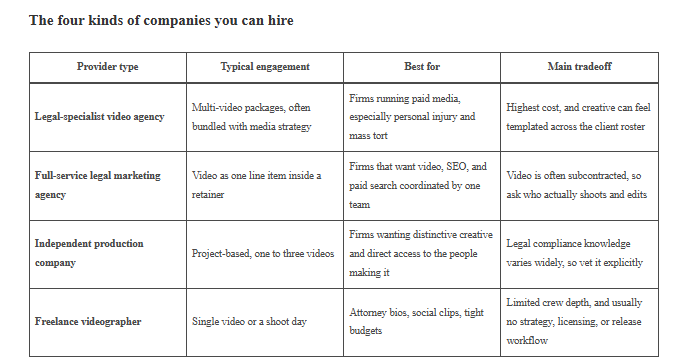
The four kinds of companies you can hire
| Provider type | Typical engagement | Best for | Main tradeoff |
|---|---|---|---|
| Legal-specialist video agency | Multi-video packages, often bundled with media strategy | Firms running paid media, especially personal injury and mass tort | Highest cost, and creative can feel templated across the client roster |
| Full-service legal marketing agency | Video as one line item inside a retainer | Firms that want video, SEO, and paid search coordinated by one team | Video is often subcontracted, so ask who actually shoots and edits |
| Independent production company | Project-based, one to three videos | Firms wanting distinctive creative and direct access to the people making it | Legal compliance knowledge varies widely, so vet it explicitly |
| Freelance videographer | Single video or a shoot day | Attorney bios, social clips, tight budgets | Limited crew depth, and usually no strategy, licensing, or release workflow |
There is no universally correct answer here. A twelve-attorney business litigation firm that needs credible partner bios has a different problem than a personal injury firm buying broadcast inventory. What matters is matching the provider’s demonstrated capability to the job in front of you.
One useful screen: ask any candidate to describe a legal advertising rule that changed how they produced something. A company with genuine legal experience will have a story. A company without one will answer in generalities about storytelling.
What law firm video costs in 2026
Published pricing for law firm video varies by roughly an order of magnitude, and most of that variance is legitimate. It reflects crew size, shoot days, location count, and post-production scope.
Atty Finders’ 2026 pricing guide puts common formats in these ranges:
| Video type | Published range (Atty Finders, 2026) |
|---|---|
| Attorney bio video | $3,500 to $12,000 |
| Practice area explainer | $5,000 to $15,000 |
| Client testimonial (per testimonial) | $4,000 to $10,000 |
| Brand film or firm overview | $15,000 to $45,000 |
| TV or OTT commercial | $25,000 to $80,000+ |
| Social and vertical content package | $6,000 to $18,000 |
| Documentary case study | $20,000 to $60,000 |
At the other end of the market, Video Case Story’s 2026 cost analysis describes local production companies delivering testimonial video in the $2,000 to $5,000 per video range, and single-day packages starting around $3,000 that yield several finished pieces.
Both pictures are accurate for different segments of the market. A boutique studio producing an attorney bio on a half-day shoot with a two-person crew genuinely costs less than a legal-specialist agency producing a broadcast spot with licensed music, a voiceover talent, and a media plan attached.
The practical takeaway for a buyer is that a quote only means something when you can see what sits underneath it. Atty Finders notes that camera equipment accounts for only about five to eight percent of a production budget, with the rest going to crew, time, locations, and editing. When two quotes differ by 300 percent, the difference almost always lives in shoot days, crew size, and revision rounds.
Ask every candidate to break a quote into pre-production, shoot day, post-production, licensing, and revisions. A company that cannot or will not itemize is quoting a number with no scope attached to it.
The compliance questions most firms forget to ask
This is where a generalist production company most often creates work you cannot use.
Ad filing requirements. Several states require lawyer advertisements to be submitted to the bar for review. The Florida Bar requires most television, radio, print, and internet advertisements to be filed under Rule 4-7.19 unless the ad contains only presumptively valid content under Rule 4-7.16, with a filing fee of $250 when filed at least 20 days before use and $750 when filed late. The Bar responds within 15 days of a complete filing. Texas Rule 7.04(a) requires filing a copy of the advertisement, a completed application, and a fee, either within 10 days after dissemination or at least 30 days before first dissemination if the firm wants pre-approval.
If your production timeline does not include the review window, your launch date is fiction. Ask candidates whether their schedule accounts for it.
Actor portrayals and dramatization. New York Rule 7.1(c) prohibits advertisements that use “actors to portray a judge, the lawyer, members of the law firm, or clients” or that depict fictionalized events without disclosure. A reenactment of a car accident, a courtroom scene shot with hired talent, or a “client” interview performed by an actor can all trip this. A production company that pitches a dramatized narrative without raising disclosure is telling you something about its experience.
Required disclaimers. New York Rule 7.1(e) requires that permitted claims about results carry the statement “Prior results do not guarantee a similar outcome,” and that communications be labeled “Attorney Advertising” outside of certain formats including radio, television, and billboards. Disclaimers have to be legible on screen and audible where required, which makes them a production decision that belongs in the edit. Ask how the company handles on-screen disclaimer duration, contrast, and placement.
Retention. New York Rule 7.1(k) requires advertisements to be retained for at least three years after initial dissemination, with computer-accessed communications retained for at least one year and website content preserved at publication, at major redesigns, and at least every 90 days. That means someone has to archive versions. If your production company deletes project files after 90 days, you have a records problem.
These are examples drawn from a much longer list, and the rules differ meaningfully by state. Your firm’s ethics counsel makes the final call. The point for hiring purposes is narrower: a partner who knows these categories exist will build them into the timeline and the edit, and a partner who does not will hand you a finished video and an unbudgeted problem.
Client testimonials carry the most upside and the most risk
Testimonial video converts well because a former client saying something specific is more persuasive than a firm saying anything about itself. It is also the format where legal video most often goes wrong.
Three requirements should appear in any competent testimonial workflow:
- Written informed consent, obtained before the interview. Model Rule 1.6(a) makes client information confidential absent informed consent, and a release that covers likeness but not the disclosure of the representation itself is incomplete. New York Rule 7.1(e) specifically requires written informed consent for testimonials from clients with pending matters.
- A pre-interview that establishes what will and will not be discussed. Case facts, settlement figures, and opposing party details are the usual danger zones. A production company that walks in cold and asks open-ended questions on camera is generating footage your ethics counsel may have to kill.
- A review path before publication. Someone at the firm with authority over advertising compliance should approve the cut, and the schedule should have room for that approval.
Ask candidates to walk you through their testimonial process step by step. The answer tells you within two minutes whether they have done this for a regulated profession.
Who owns the footage
This is the contract term firms most often skip and most often regret.
Under U.S. copyright law, the person who creates a work owns the copyright by default. A commissioned video becomes a work made for hire only through an express written agreement signed by both parties that states the work is made for hire, and only for works falling within one of nine statutory categories. Motion pictures and other audiovisual works are among those nine categories, so the mechanism is available, but it requires the signed writing. Absent that agreement or a written assignment, the production company owns the copyright and you hold whatever license the contract grants.
That distinction has practical consequences. A limited license can restrict where you run the video, for how long, and in what markets. It can also mean you cannot recut the footage next year when a partner leaves, when your firm rebrands, or when you want fifteen social clips out of a shoot you already paid for.
Four questions settle it:
- Does the firm own the copyright in the finished video, or hold a license? If a license, what are its term, territory, and media limits?
- Do we receive the raw footage, and in what format?
- Do we receive project files and the editable timeline?
- Is licensed music covered for broadcast and paid social, or only for organic use?
Music licensing deserves its own mention. A track licensed for web use will not cover a television buy, and a claim on a paid campaign is an expensive way to discover the gap.
The 12 questions to ask before you sign
- What legal advertising rules in our state affect this project, and how does your timeline account for filing or review?
- Have you produced video for a law firm before, and can we see it?
- Who is physically on set, and are they employees or subcontractors?
- What is your testimonial consent process, and who drafts the release?
- How do you protect confidential material visible in our office during filming?
- Does the firm own the copyright, or receive a license?
- Do we get the raw footage and project files?
- Is the music cleared for paid media and broadcast?
- How many revision rounds are included, and what does an additional round cost?
- What is the total elapsed time from kickoff to final delivery?
- What deliverables and aspect ratios are included, including vertical cutdowns and captions?
- Who directs the attorney on camera, and what is your approach to coaching someone who is not a performer?
That last question separates competent legal video from the rest. Attorneys are trained to be precise and cautious, which reads as stiff on camera. Getting a warm, natural take out of a litigator requires an interviewer who knows how to ask a better question.
Red flags
- A quote with no itemization, or a single number for an undefined scope.
- No written contract, or a contract silent on copyright and usage.
- A reel with no legal or professional services work and no acknowledgment of the gap.
- A pitch built on dramatized scenarios with no mention of disclosure requirements.
- Guaranteed case volume, guaranteed rankings, or promised ROI figures. Results claims about your marketing are as unverifiable as results claims in your marketing.
- Unlimited revisions offered upfront, which usually signals that the discovery process is thin and rework is expected.
- Reluctance to hand over raw footage at any price.
How to evaluate a reel
Watch a candidate’s work with the sound off first, then with the sound on and your eyes closed. The first pass tells you whether the images hold attention on their own. The second tells you whether the audio is clean, because bad audio is the single most common reason a professionally shot video feels amateur.
Then look for three specific things in any legal work they show:
- Does the attorney sound like a person? Scripted delivery reads as a commercial, and legal buyers discount commercials.
- Is the firm distinguishable? Stock footage of a gavel, a scale, and a downtown skyline describes every firm in America and identifies none of them.
- Does the video answer a question a real client would ask? “What happens after I file” is worth more than “we are dedicated to fighting for you.”
Practice area changes the brief
Personal injury and mass tort firms are usually buying attention in a paid media environment, which pushes toward broadcast-quality production, disclaimer discipline, and volume. Business litigation, defense, and transactional firms are usually buying credibility with a smaller, more sophisticated audience, which pushes toward attorney bios, practice explainers, and thought leadership that a general counsel would actually watch. Family, immigration, and estate planning firms sit closer to the personal injury end on emotion and closer to the business end on budget, and they benefit most from educational content that answers the questions clients are too anxious to ask.
Tell a prospective partner which of those you are, and listen to whether their recommendation changes. If the pitch is identical regardless of your answer, you are being sold a package with your name typed at the top.
A note on where we sit
We produce video at Aktion Productions, and law firms are one of the industries we work with, so this guide reflects a point of view. We have also published a ranking of the top law firm video production companies of 2026, and we are not the right fit for every firm on this page. A personal injury firm buying broadcast inventory in a top-ten market should probably talk to a legal-specialist agency built for that. A firm that wants distinctive creative and direct access to the people making it is a better match for a studio like ours. Either way, the questions above are the ones worth asking, including of us.
Frequently asked questions
How long does law firm video production take?
Four to eight weeks from kickoff to final delivery is typical for a single video, and longer if your state requires the advertisement to be filed for bar review before use. The Florida Bar responds within 15 days of a complete filing under Rule 4-7.19, and Texas allows pre-approval submissions at least 30 days before first dissemination under Rule 7.04(a). Build the review window into the schedule from the start.
Do I need a video production company that specializes in law firms?
No, but you need one that understands regulated advertising, confidentiality, and consent. A generalist studio that asks the right compliance questions and builds releases and review time into the process will serve you better than a legal specialist producing templated work. Specialization is a useful proxy for competence, and the underlying competence is what you are actually buying.
Who owns the raw footage after a law firm video shoot?
The production company owns it by default under U.S. copyright law unless your contract transfers ownership through a signed work-made-for-hire agreement or a written assignment. Many contracts grant only a license to the finished video, which can limit where and how long you can run it and can prevent you from recutting the footage later. Settle this in writing before the shoot.
Can law firms use client testimonials in video?
Yes in most jurisdictions, subject to conditions. New York Rule 7.1(d) permits client testimonials, and Rule 7.1(e) requires written informed consent when the client’s matter is pending, factual support for claims, and the disclaimer “Prior results do not guarantee a similar outcome” where results are referenced. ABA Model Rule 1.6(a) requires informed consent before revealing information relating to the representation. Rules vary by state, so confirm your jurisdiction’s requirements before you book the shoot.
How much should a small law firm budget for its first video?
A single attorney bio video is the most common starting point. Atty Finders’ 2026 guide puts that format at $3,500 to $12,000, while Video Case Story reports local production companies delivering single videos in the $2,000 to $5,000 range, so a realistic first budget sits somewhere between those two figures depending on crew size and finish. A single shoot day producing several pieces at once generally delivers more usable content per dollar than commissioning videos one at a time.
This article describes general professional conduct requirements for informational purposes and is not legal advice. Advertising rules vary by jurisdiction, and your firm’s ethics counsel should review any advertisement before it runs.

Looking for a Top Rated Orlando Video Production Company?
Use Orlando's Trusted Choice
Don't settle for subpar video content. With years of experience in both corporate and creative video production, we are the trusted choice for Orlando video production. Whether you're looking to capture your brand's story or create compelling advertising campaigns, we have the expertise to make your vision a reality.