Choose a healthcare video production company on process before portfolio. Ask how they get patient consent, how many review rounds they include, who owns the raw footage, and whether they have actually filmed inside a clinical space. A beautiful reel tells you someone can operate a camera, and it tells you nothing about whether they can get a signed HIPAA authorization before the crew walks in.
That last part is not a hypothetical. In 2018 three Boston hospitals paid a combined $999,000 to settle with the HHS Office for Civil Rights after film crews were let into patient areas without advance authorization. Nothing that aired caused it, and the access did.
The short version
Six things matter more than everything else combined.
- Ask how they handle patient consent. You want authorization signed before the crew arrives. Anyone who says they blur faces afterward has told you they do not know the rules.
- Ask how many review rounds are included, and whether the physician reviewer’s notes count as one of them. This is where healthcare budgets overrun.
- Ask who owns the raw footage, and get it in writing.
- Match the company to the lane. Practice marketing, hospital enterprise work and pharma animation are three different businesses that happen to share a job title.
- Judge the reel on whether people look real on camera, because polish is the easiest thing to buy.
- Compare quotes on the same basis. Per-minute animation and per-project live action are different math.
What makes healthcare video different from corporate video?
Four things change the moment the subject is clinical.
Patients are protected people. Anyone identifiable on screen needs written HIPAA authorization obtained in advance. OCR guidance is blunt about this. Masking someone afterward does not fix a missing authorization, and you cannot make signing a condition of treatment. A crew that has only ever filmed in offices has no workflow for this, and nobody builds one mid-shoot.
Clinical claims get reviewed. A corporate video calls the company innovative and nobody checks. A healthcare video that explains a recovery timeline gets read by a physician, usually by a compliance officer, and in device and pharma work by a medical, legal and regulatory committee. Scripts written without a clinician in the room come back covered in red.
The room fights you. Sterile fields decide where equipment stands. Imaging suites have magnets. Treatment rooms have monitors full of patient data that need screening or repositioning. Clinical schedules never move for production schedules, which is why healthcare shoots so often start before six in the morning.
Your audience is already skeptical. rater8 surveyed 1,008 US patients in December 2024 and found 84% read online reviews before picking a new provider, 51% read at least six, and 61% trust those reviews over recommendations from friends and family. By the time someone reaches your video, they have done homework. They are looking for confirmation, and that changes what the video has to do. Our page on healthcare video marketing statistics digs into that research.
What kind of company should you hire?
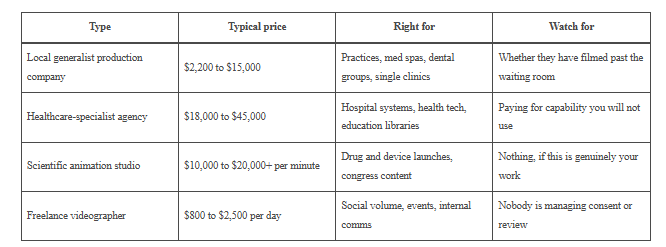
Most bad healthcare video hires come down to a category error, where somebody hires a company whose business model does not fit the work. Sort the field into four groups first.
| Type | Typical price | Right for | Watch for |
|---|---|---|---|
| Local generalist production company | $2,200 to $15,000 | Practices, med spas, dental groups, single clinics | Whether they have filmed past the waiting room |
| Healthcare-specialist agency | $18,000 to $45,000 | Hospital systems, health tech, education libraries | Paying for capability you will not use |
| Scientific animation studio | $10,000 to $20,000+ per minute | Drug and device launches, congress content | Nothing, if this is genuinely your work |
| Freelance videographer | $800 to $2,500 per day | Social volume, events, internal comms | Nobody is managing consent or review |
The local generalist
Films weddings, corporate interviews, events and commercials, with healthcare as one vertical among several. This is the right call when the content is a physician on camera in their own building. Ask directly whether they have worked inside a clinical space, because the honest ones will tell you.
The healthcare specialist
Works only or mostly in healthcare, usually animation-led and usually national. Right when medical accuracy is the hard part of the job. The specialization is real and so is the premium, so a single physician introduction filmed in one afternoon is an expensive way to use them.
The scientific animation studio
Builds 3D mechanism-of-action and mechanism-of-disease work for pharma, biotech and device companies, staffed with people holding science degrees alongside the film degrees. If your content describes a biological process, this is your category. If it does not, this is the wrong aisle entirely.
The freelancer
One person, sometimes two. Fast, affordable and excellent for volume social content. The gap is that no producer exists, so nobody is chasing consent forms, managing clinical review or negotiating with the OR schedule. On a simple shoot that is fine, and on anything with patients it becomes a real problem.
Our ranked comparison of the best healthcare video production companies sorts named companies into these four lanes.
Which compliance questions do most organizations forget to ask?
These separate a company that has done healthcare work from one that says it has.
“Walk me through your patient consent process.” You want to hear about written authorization obtained before the shoot, on a form your compliance team has reviewed, with a record retained. You do not want to hear about blurring, pixelation, or getting a release on the day.
“Who confirms no unauthorized patient ends up in the background?” On a working floor this is a live risk in every wide shot. A crew that has thought about it will describe a designated escort and a closed set. A crew that has not will go quiet.
“What happens to monitors showing patient information?” Privacy screens and repositioning are the right answers. OCR guidance specifically flags electronic patient data visible on screens as something requiring safeguards even when you hold every authorization.
“What if a patient withdraws consent later?” Authorization can be revoked. A company that can describe pulling footage and reissuing cuts has lived through it.
“Who signs off on the final cut, and is that inside your timeline?” Clinical and legal review is neither optional nor quick, so if it sits outside the agency’s schedule, every delay becomes your problem.
“Have you worked with an MLR committee?” Only relevant in pharma and device work, and decisive when it applies. Agencies new to MLR routinely underestimate it by months.
“What is your position on before-and-after imagery?” Healthcare advertising carries FTC truth-in-advertising obligations stacked on top of HIPAA. Results shown have to be typical. A company that has never raised this with a client has not been paying attention.
Why are patient testimonials the riskiest video you can make?
Testimonials are the format patients respond to most and the one that creates the most exposure, which is an awkward combination to manage.
The upside is easy to see. With 61% of patients trusting reviews over friends and family, a named patient telling their own story on camera is the most credible asset a provider can publish.
The risks are specific. Appearing on screen reveals that this person is your patient and usually what they were treated for, and both are protected health information. Consent has to be informed, which means they understand the video may run on the open internet indefinitely. It can be revoked. FTC rules also require the experience shown to reflect what a typical patient could expect, which limits who you can feature.
Five questions for anyone proposing testimonial work:
- Who drafts the authorization form, and has a healthcare attorney read it?
- Does it cover every platform you plan to use, paid social included?
- Is there a stated term, and what happens when it ends?
- How do you handle someone who wants the video pulled in two years?
- Are you recruiting the patients, or are we?
A company that answers these quickly has done the work. A company that hands them back to you is quoting for corporate video and will deliver the liability with the invoice.
What should healthcare video cost, and how do you compare quotes?
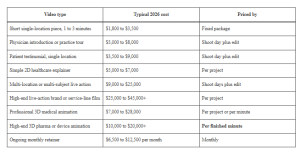
Here is what named agencies published in 2026.
| Work | Published range |
|---|---|
| Short single-location piece, 1 to 3 minutes | $1,800 to $3,500 |
| Simple healthcare explainer | $5,000 to $7,000 |
| Professional 3D medical animation | $7,000 to $28,000 |
| Animation from a healthcare specialist | $18,000 to $25,000 |
| High-end live action | $25,000 to $45,000+ |
| High-end pharma or device 3D animation | $10,000 to $20,000+ per minute |
| Monthly retainer | $6,500 to $12,500 |
Clutch’s September 2026 data, built from verified client reviews, shows most US video agencies billing $100 to $149 an hour, an average project of $42,281, and a typical project under $10,000. That gap tells you the market is really two markets.
Three rules for reading quotes.
Convert to a common basis first. Per-minute animation and per-project live action describe different things, so work out total deliverable cost before deciding which one is expensive.
Count the shoot days alongside the price. Days are most of the cost in live action, so a quote that looks 30% higher while including an extra day is usually the cheaper one.
Read the revision clause. Two rounds is standard in corporate video and thin in healthcare, where the clinical reviewer and the legal reviewer will each have notes. Ask whether those count as one round or two.
Our full cost breakdown works through every factor.
Who should own the raw footage?
You should want to, and this gets settled in the contract or it gets settled badly later.
Three arrangements are common. The agency keeps ownership and licenses you the finished cuts, which is the industry default and the most restrictive. You own the deliverables while the agency keeps the raw footage, which is the usual middle ground. Or you own everything, which costs more and earns it if you plan to re-edit.
Healthcare adds a compliance argument on top of the commercial one. That footage contains protected health information, so if a patient revokes authorization you need certainty that the files are destroyed or sequestered. Certainty is hard to come by when a third party holds the only copy under terms you did not write.
Ask where footage is stored, for how long, whether it is encrypted, and whether the company will sign a business associate agreement. Plenty of general production companies have never been asked for a BAA and will not know the term, which tells you something on its own.
How do you evaluate a healthcare reel?
Polish is the cheapest thing on screen and the worst predictor of whether the video will work. Look for four other things.
Do the clinicians look comfortable? Physicians are the most common subject in healthcare video and among the hardest to direct. If every doctor in the reel looks stiff and over-rehearsed, the company cannot get a real performance out of a non-actor, and that is most of the job.
Is there footage from inside a clinical space? Lobbies and exteriors are easy. An operating room, a treatment bay or an imaging suite means somebody got credentialed, escorted and made it work under real constraints.
Does the audio hold up? Clinical rooms are acoustically hostile, full of hard surfaces, HVAC and equipment hum. Clean dialogue in a treatment room says more about competence than any camera move.
Do the patients look real? Stock-looking actors in scrubs usually mean the company has never navigated a consent process and is routing around it. Fine for some content, disqualifying for testimonials.
The 14 questions to ask before you sign
- What healthcare work have you done, and can I speak to two of those clients?
- Have you filmed inside a clinical environment, and which ones?
- Walk me through your patient consent process from first contact to publication.
- Will you sign a business associate agreement?
- Where is footage stored, for how long, and is it encrypted?
- Who owns the raw footage after delivery?
- How many revision rounds are included, and does clinical reviewer feedback count as one?
- What happens when a clinical reviewer rejects a script claim late?
- Who is on the crew, and are they employees or freelancers booked per project?
- Will the person pitching me be the person on set?
- How do you handle a patient who withdraws authorization after publication?
- What is billed separately, specifically travel, music licensing, captions, vertical cut-downs and extra deliverables?
- How will we measure this, and how will you attribute phone calls? Ruler Analytics puts 39.2% of healthcare conversions on the phone, so a plan built only on form fills will undercount by about a third.
- What would make you tell me this project is not a good fit for you?
Number 14 is the most useful question on the list. A company with judgment will have a real answer, and a company that says yes to everything has just told you something important.
Six red flags
“We’ll blur the patients’ faces.” The clearest possible signal that a company does not understand HIPAA, because masking does not substitute for advance authorization.
No producer on the project. Somebody has to run consent forms, clinical schedules and review cycles. If nobody is named, congratulations, it is you.
A portfolio with no healthcare work and total confidence that healthcare is easy. The confidence is the tell.
Pricing well below the published floor. Medical projects start around $2,200 to $3,500 in the US market, so a $900 patient testimonial quote means something got left out, and it is usually the compliance work.
Refusing to discuss footage ownership before contract. This never gets better after you sign.
Untraceable statistics in the pitch deck. If the proposal claims viewers retain 95% of a video message or that video lifts landing page conversion 80%, you are reading marketing folklore. Both figures fall apart under thirty seconds of scrutiny, as our statistics page explains.
How does specialty change the brief?
Hospitals and health systems need coordination more than flash, because approval runs through marketing, service-line leadership, legal and compliance. Ask about project management capacity alongside camera packages.
Surgical and procedural specialties need a crew that can work a sterile field and an editor who knows what cannot be shown. Ask to see operating room work specifically.
Med spas and aesthetics live on before-and-after imagery, which is FTC territory as much as HIPAA territory. Results have to be typical, so a company that has not raised this has not done the work.
Dental is high-volume, high-repetition marketing where consistency and cost per asset beat any single hero piece.
Behavioral and mental health is the most sensitive category of all, since identifying a patient carries real consequences. BrightEdge also found mental health queries have the lowest AI Overview coverage of any healthcare specialty at 63%, which makes traditional organic content unusually valuable here.
Medical device and pharmaceutical work is MLR-governed and animation-heavy, so hire a scientific animation studio.
A note on how we work
We produce video at Aktion Productions, so treat this guide as a point of view with a company behind it.
Our process has three phases, and we call it the Aktion Method: Plan, Roll, Cut. Plan is where consent forms get drafted, subjects get batched into the same morning and the shot list gets built around the review cycle. Roll is the shoot. Cut is edit, color, sound and delivery.
Norbert Vasko, who founded the company in 2007, puts it this way: most of what goes wrong on a healthcare shoot was decided weeks earlier, in a conversation nobody had. That is why Plan carries the weight it does.
We are the wrong choice for plenty of organizations. A drug launch needing mechanism-of-action animation should hire a studio with PhDs on staff. A national health system filming in fifteen states will do better with a crew network. We publish a ranked comparison of healthcare video production companies that includes companies we compete with, so you have something to check us against.
Frequently asked questions
Do I need a healthcare specialist, or can a general production company handle it?
It comes down to whether patients appear on camera and whether the video makes clinical claims. A physician introduction filmed in an empty office sits comfortably within a good general company’s range, as long as they have a producer. Patient testimonials, procedural footage and anything needing clinical sign-off favor someone who has done it before.
How long does healthcare video production take?
Three to four weeks for simple single-location work, and eight to twelve weeks for something substantial, which is the published norm among healthcare specialists. Anything passing through an MLR committee should be planned at twelve weeks or more, because the review calendar sets the pace.
What is a business associate agreement, and do I need one with my video company?
A BAA is a contract required under HIPAA when a vendor creates, receives, maintains or transmits protected health information for a covered entity. Whether yours needs one is a question for your counsel, and a production company sitting on footage of identifiable patients is a reasonable candidate. The useful test is whether the company knows what you are asking when you bring it up.
Can we film in the operating room?
Yes, with advance authorization from every patient who will appear, a credentialed escort, sterile field protocol and a window set by the clinical schedule. Expect fewer usable setups per day and a higher day rate than the same crew in a conference room.
Who should own the raw footage?
You should want to own it, and healthcare gives you a compliance reason on top of the commercial one, since footage holding protected health information should sit under your control if a patient revokes consent. Expect to pay a little more for full ownership, and get the storage and destruction terms in writing either way.
How do we know whether the video worked?
Agree the measurement plan before production starts. Roughly 39% of healthcare conversions arrive by phone, so the plan needs call tracking on the pages carrying video, alongside view and engagement data. Be skeptical of any agency promising a specific conversion lift, because no credible study isolates the effect of healthcare video well enough to back a number like that.

Looking for a Top Rated Orlando Video Production Company?
Use Orlando's Trusted Choice
Don't settle for subpar video content. With years of experience in both corporate and creative video production, we are the trusted choice for Orlando video production. Whether you're looking to capture your brand's story or create compelling advertising campaigns, we have the expertise to make your vision a reality.