Healthcare video costs between $2,200 and $45,000 per video in 2026. Most practices land between $3,000 and $9,000 for a single piece. Hospital service-line films run $15,000 to $45,000, and high-end 3D medical animation is quoted per finished minute at $10,000 to $20,000 and up. Ongoing production usually moves to a monthly retainer somewhere between $6,500 and $12,500.
That is a wide range, and the width is the whole point of this page. Below is what sits behind each number, drawn from rates that named agencies publish on their own sites.
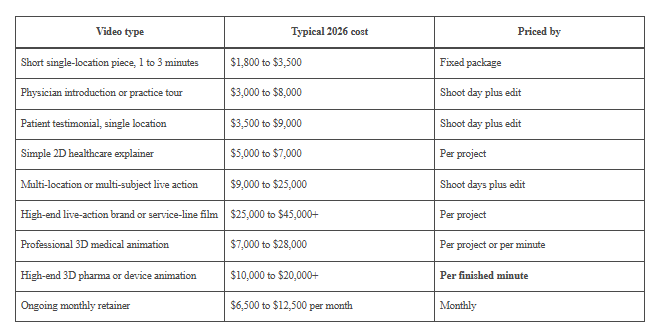
Quick answer: healthcare video costs by type
| Video type | Typical 2026 cost | Priced by |
|---|---|---|
| Short single-location piece, 1 to 3 minutes | $1,800 to $3,500 | Fixed package |
| Physician introduction or practice tour | $3,000 to $8,000 | Shoot day plus edit |
| Patient testimonial, single location | $3,500 to $9,000 | Shoot day plus edit |
| Simple 2D healthcare explainer | $5,000 to $7,000 | Per project |
| Multi-location or multi-subject live action | $9,000 to $25,000 | Shoot days plus edit |
| High-end live-action brand or service-line film | $25,000 to $45,000+ | Per project |
| Professional 3D medical animation | $7,000 to $28,000 | Per project or per minute |
| High-end 3D pharma or device animation | $10,000 to $20,000+ | Per finished minute |
| Ongoing monthly retainer | $6,500 to $12,500 per month | Monthly |
Pay attention to the last row before the retainer. High-end animation is sold by the minute, so a ninety-second pharma piece at $15,000 per minute is a $22,500 project. Two quotes with the same runtime can be built on completely different math.
Why is healthcare video more expensive than corporate video?
Three reasons, and none of them are about cameras.
Patients are protected people. Anyone identifiable on screen needs written HIPAA authorization signed before the crew shows up. That means a form your compliance team has read, a record you keep, and a plan for what happens if someone changes their mind later.
Clinical claims get reviewed. A corporate video says the company is innovative and nobody checks. A healthcare video that explains a procedure gets read by a physician, usually by legal, and in device and pharma work by a full medical, legal and regulatory committee.
Clinical spaces are hard to film in. Sterile fields decide where your tripod goes. Someone credentialed has to walk the crew in. Monitors showing patient data need privacy screens or a nudge out of frame. The OR schedule wins every argument, which is why so many healthcare shoots start at 5am.
A crew that has never worked in healthcare quotes as though none of this exists. That quote will look great until week three.
What named agencies actually publish
Industry “average cost” numbers for video are close to useless, because the sample is always self-selected. Here is what real companies post on their own websites.
Zip In Media Productions sells fixed packages at $1,800 for one minute, $2,400 for two and $3,200 for three, and says medical projects typically start around $2,200 to $3,500. That is the clearest published floor in the US market.
VOKA puts simple healthcare explainers at $5,000 to $7,000, and high-end 3D pharma or device animation at $10,000 to $20,000 per minute or more.
Think Branded Media puts high-end live-action healthcare work at $25,000 to $45,000 and up, professional 3D animation at $7,000 to $28,000, and crew days around $2,500 with medical compliance consultants included.
Demo Duck publishes $18,000 to $25,000 for animation and $25,000 to $45,000 for live action, on timelines of 8 to 12 weeks.
Aktion Productions publishes retainers by tier. Signature starts at $6,500 a month and covers two shoot days, two hero videos and six to eight social cut-downs. Studio starts at $12,500 and covers four shoot days, twelve or more social assets and a dedicated producer. Buying the same Signature deliverables one project at a time runs about $11,789.
Clutch aggregates verified client reviews, and as of September 2026 it reports most US video agencies billing $100 to $149 an hour. Its average project is $42,281, while its typical project sits under $10,000. A handful of enormous engagements drag that average around, so nobody should budget off it.
The seven things that move a healthcare video quote
1. Shoot days
For live action, this is the whole ballgame. A crew day with real lighting, real audio and a producer runs about $2,500 at the low end and $4,000 or more for a bigger unit. Add a second day to a $6,000 project and the days are now most of your budget.
The fastest way to bring a quote down is to stop spreading the work out. Four physicians filmed across four mornings is four shoot days. The same four filmed in one morning is one.
2. Whether patients appear on camera
This is the cost factor unique to healthcare, and it is the one people forget to budget for. Filming a real patient means advance written authorization, compliance review of the form, and usually another set of eyes on the final cut.
In 2018 the HHS Office for Civil Rights settled with Boston Medical Center, Brigham and Women’s Hospital and Massachusetts General Hospital for a combined $999,000. Film crews had been let into patient areas without advance authorization. The footage was never the problem, and the access was.
A crew that knows this builds consent into pre-production and charges for it. A crew that does not will come in cheaper and hand you the exposure for free. Budget $1,000 to $3,000 of extra pre-production and review for genuine patient testimonial work.
3. Review rounds
Most contracts include two rounds of revisions, which is generous for a corporate video and thin for a healthcare one. Your marketing lead has notes, then the physician reviewer has notes, then legal has notes. In pharma and device work an MLR committee has notes, and they arrive on the committee’s calendar.
Ask two questions before signing. How many rounds are included, and does clinical reviewer feedback count as one of them? Agencies that live in regulated healthcare price this in, while agencies that do not will bill the overage hourly.
4. Filming inside a clinical environment
Operating rooms, imaging suites and treatment bays are the most expensive rooms you can film in, for reasons that have nothing to do with the shot. You lose setups to sterile protocol, you lose time to escorts and credentialing, and you lose your preferred call time to the surgical schedule.
Assume a clinical-environment day costs 25% to 50% more than the same crew in a conference room, and assume you get less out of it.
5. Live action or animation
These are two different cost models wearing the same name.
Live action front-loads everything into the shoot. Once footage exists, more cuts are cheap, which is why a retainer can turn two shoot days into eight social pieces without doubling the price.
Animation front-loads everything into modeling and design. Building a 3D heart valve is expensive, and re-rendering it is not, so your second animation using those assets costs far less than the first. Pharma animation is sold by the finished minute because the labor tracks screen time.
The rule of thumb is simple. Anything involving a real person is live action, and anything happening inside the body is animation.
6. Talent and usage rights
Actors, hand models and voiceover all come with terms attached. A voiceover with full buyout costs more than a limited-term license, and you find out which one you bought three years later when the video stops being legal to run. Licensed music runs roughly $500 to $750 for pre-recorded tracks.
Footage ownership is a separate question from price, and it belongs in the contract. Our guide to choosing a healthcare video production company covers the language worth looking for.
7. How often you shoot
One-off production carries the highest unit cost, because every project pays again for discovery, scheduling and setup. Clutch’s finding that the average engagement runs five months reflects where most healthcare organizations end up.
The published numbers make the case. Aktion’s Signature tier delivers at $6,500 a month what costs roughly $11,789 bought one project at a time, which is about a 45% difference for the same output. The catch is the commitment, at three months for Signature and six for Studio.
What each type of healthcare video costs
Physician introduction or “meet the doctor”
$3,000 to $8,000 per physician, or $1,500 to $3,000 each when you batch them.
Pound for pound, these are the best value in healthcare video. Patients show up having already read a stack of reviews, and a two-minute introduction confirms the person in those reviews is the person they will meet. No patients on camera means light compliance, and batching is your main lever.
Patient testimonial
$3,500 to $9,000 per testimonial.
The shoot is easy. What you are really buying is the authorization, the review and the legal overhead. Filming three patients in one day drops the per-piece cost a lot, though finding three willing patients is usually harder than booking the crew.
Facility or practice tour
$2,500 to $6,000.
Simple if you film outside clinical hours with nobody in the building. The price climbs fast during operating hours, because every frame has to be checked for a patient who wandered into the background.
Patient education or procedure explainer
$5,000 to $15,000 live action, $7,000 to $28,000 for 3D animation.
Clinical accuracy drives this one. A physician has to help write it, and the script has to survive review. Animation is usually the better call for anything anatomical, and it skips the patients and the clinical location entirely.
Service-line or brand film
$15,000 to $45,000+.
Multiple locations, multiple subjects, a scripted narrative, often drone and specialty camera work. This is hospital and large specialty group territory, and it is where Clutch’s $42,281 average comes from.
Recruitment video
$5,000 to $20,000.
Plenty of health systems now spend their biggest video budget here, because an unfilled nursing line costs more than any video. Expect several staff interviews plus facility and community footage.
Medical device or pharmaceutical animation
$10,000 to $20,000+ per finished minute.
Sold by the minute, reviewed by a committee, and built by studios with actual scientists on staff. Visual Science describes a typical 90-second high-end animation as a six-week build and notes that roughly a quarter of its team are software engineers. General production companies should not be bidding here.
Social cut-downs
$150 to $400 each from existing footage, $1,000+ shot natively.
The cheapest thing you will buy and the thing most often left off the quote. If the footage already exists, vertical cuts are an editing line item, so ask for them at the start instead of as a change order.
What should a healthcare organization budget for a year?
These are illustrative scenarios built from the rates above.
Single-location practice getting started. One physician introduction, one facility tour, two patient testimonials and social cut-downs, filmed across two consolidated days. Roughly $9,000 to $16,000.
Multi-provider specialty group. Six physician introductions batched into two days, four testimonials, one service-line explainer and monthly social. Roughly $35,000 to $60,000 in year one, or a retainer around $6,500 a month.
Hospital or health system. Service-line films for three or four specialties, a recruitment campaign, a patient education library and continuous social. $150,000 to $400,000 a year, usually split between a retainer and project work.
Medical device launch. One 90-second mechanism-of-action animation, one live-action procedure film, plus conference and sales cuts. $60,000 to $150,000 for the package.
Seven ways to spend less without buying worse video
- Consolidate shoot days before you negotiate rates. Squeezing two days into one saves more than any discount you will talk someone into.
- Batch your on-camera subjects. Six physicians in one morning costs a fraction of six separate visits.
- Film outside clinical hours where the content allows it, because an empty building is faster, cheaper and far simpler on compliance.
- Pay properly for one hero piece and treat the social cuts as an editing line item on the same job.
- Use animation to skip clinical access. Anatomical and procedural content in animation avoids the OR, the escort, the privacy screens and the 5am call.
- Front-load the consent work. Chasing authorizations after the shoot is how healthcare video budgets actually die, because the fallback is reshooting.
- Buy the review rounds you actually need. Hourly overage is the most expensive way anyone has ever paid for revisions.
How the process affects what you pay
Most of the savings above come down to sequencing, which is why process matters more than gear. At Aktion we run everything through three phases we call the Aktion Method: Plan, Roll, Cut.
Plan is where consent forms get drafted, physicians get scheduled into the same morning and the shot list gets built against the review cycle. Roll is the shoot. Cut is the edit, color, sound and delivery in every format you need.
The reason we put so much weight on Plan is financial. Almost every expensive surprise in healthcare video, from the missing authorization to the third unbudgeted revision round, traces back to something that should have been settled before anyone picked up a camera.
Frequently asked questions
What is the minimum realistic budget for a healthcare video?
Around $2,200 to $3,500 for a short single-location piece with no patients on camera, based on Zip In Media’s published medical starting range. Below that you are buying a videographer with a camera, which is fine for raw social content and risky for anything carrying a clinical claim.
Is a video retainer cheaper than paying per project?
Per unit of output, yes, and by a lot. Published rates show roughly a 45% difference between retainer pricing and buying the same deliverables one at a time. The tradeoff is a minimum commitment of three to six months, so retainers only pay off when you genuinely have content to fill them.
Why is medical animation priced per minute?
Because the labor tracks screen time. Every second of high-end 3D animation needs modeling, lighting and rendering, so a two-minute piece costs roughly twice a one-minute piece. Live action does not work that way, since the shoot day costs the same whether you cut two minutes or five out of it. Convert both quotes to total project cost before comparing them.
Do I have to pay extra for HIPAA compliance?
You should expect to see consent and compliance work somewhere in the quote, either as a line item or inside pre-production. If a project puts patients on camera and the quote shows nothing for it, the agency either does not understand the requirement or is planning to leave that work with you.
How long does healthcare video production take?
Three to four weeks for simple single-location work. Demo Duck’s published 8 to 12 weeks is representative for something substantial. Anything going through an MLR committee should be planned at twelve weeks or more, because the review calendar sets the pace and not the edit.
Does location change the price?
Less than you would expect for the crew and more than you would expect for travel. Clutch shows US, Canadian and Australian agencies clustered at $100 to $149 an hour. What actually costs money is getting a crew to you, so a company with real presence in your market saves you travel days and per diems that add up fast across a multi-day shoot.