Choosing a real estate video production company starts with one diagnosis, which is whether you need per-listing media or brand production. Those are two separate industries that share a name, and hiring from the wrong one produces either a quote that seems absurdly high or a deliverable that feels generic. Once you know which you need, the decision comes down to six things: relevant portfolio depth, FAA Part 107 certification for aerial work, proof of insurance, written license terms for the footage, turnaround guarantees in writing, and Fair Housing awareness in how they shoot and edit. This guide covers how to evaluate each, the twelve questions to ask on a first call, and the answers that should end the conversation.
First, which kind of company do you actually need?
Almost every bad hire in this category traces back to skipping this step.
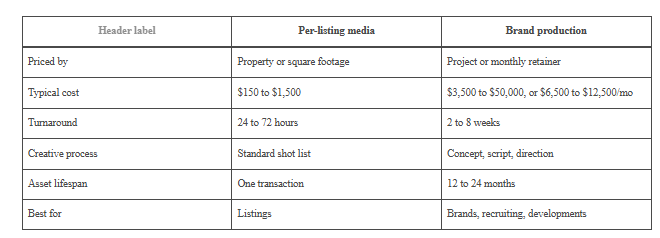
Per-listing media companies shoot several properties a day. They price per property or per square foot, deliver in 24 to 72 hours, and work from a repeatable shot list by design. Their value is speed, consistency and cost, and their creative range is deliberately narrow. Hire them for listing videos, vertical reels of a property, aerial coverage and 3D tours.
Brand production companies scope one engagement at a time. They build a creative concept, direct on-camera talent, and deliver a set of assets meant to run for a year or more. Their value is story, craft and strategic fit, and their turnaround is measured in weeks. Hire them for agent and team brand films, brokerage recruiting video, developer and pre-construction campaigns, commercial property marketing and ongoing content programs.
| Per-listing media | Brand production | |
|---|---|---|
| Priced by | Property or square footage | Project or monthly retainer |
| Typical cost | $150 to $1,500 | $3,500 to $50,000, or $6,500 to $12,500/mo |
| Turnaround | 24 to 72 hours | 2 to 8 weeks |
| Creative process | Standard shot list | Concept, script, direction |
| Asset lifespan | One transaction | 12 to 24 months |
| Best for | Listings | Brands, recruiting, developments |
Some companies do both and keep the two priced separately, which is a good sign. A company that quotes a single blended rate for both is usually strong at one of them and improvising at the other. Full pricing detail for each tier is in our real estate video production cost guide.
How much relevant portfolio depth is enough?
Ask for three examples that match your exact use case, not three examples that are merely good.
A cinematic reel of waterfront estates tells you nothing about whether a company can make a 1,400 square foot townhome look appealing, and a beautiful brokerage brand film tells you nothing about whether they can turn a listing video around before the weekend. Property type, price tier, and format all need to match.
What to look for in the samples:
- Consistent exposure between rooms. Interior video with blown-out windows and dim interiors is the most common technical failure in this category, and it is visible in three seconds.
- Stable movement. Gimbal work should be smooth without feeling like a video game. Sudden speed changes and unmotivated push-ins read as amateur.
- A coherent tour order. A good listing video moves the way a buyer would walk the home. A bad one cuts between floors at random.
- Audio that is not just music. Even in a silent walkthrough, ambient sound design separates professional edits from template exports.
- Vertical versions that were shot vertically. A horizontal video cropped to 9:16 loses the sides of every room, and you can spot it immediately.
Ask when each sample was produced. A portfolio built primarily in 2019 tells you little about how a team handles vertical-first delivery in 2026.
Is FAA Part 107 certification actually required?
Yes, for any aerial work tied to a commercial purpose, which includes every real estate listing.
Commercial drone operation in the United States requires an FAA Part 107 Remote Pilot Certificate, obtained by passing a 60-question knowledge exam covering airspace, weather and regulations, then clearing a TSA background check. The certificate requirement applies regardless of drone size and regardless of whether the aerial work is billed separately. Part 107 also imposes operating rules that affect what a pilot can legally deliver, including visual line of sight, a 400-foot altitude ceiling above ground level, daylight-only operation from 30 minutes before sunrise to 30 minutes after sunset, and a prohibition on flying over uninvolved people.
The FAA assesses civil penalties reaching tens of thousands of dollars per violation, and each unlicensed flight is counted separately.
In Florida there is a second layer. The Freedom from Unwarranted Surveillance Act (Fla. Stat. § 934.50) prohibits using a drone to capture imagery of a person or private property where there is a reasonable expectation of privacy, without written consent. In practice this means aerial shots that linger over a neighbor’s pool or backyard create exposure, and the agent who publishes that image in an advertisement is not insulated from it.
Ask for the pilot’s certificate number and confirm the airspace plan for your property. Much of Central Florida sits under controlled airspace because of Orlando International, Orlando Executive, and the surrounding fields, and authorization runs through the FAA’s LAANC system. A provider who cannot explain how they will get authorization for your address has not flown much near an airport.
What insurance should a real estate video company carry?
Ask for a certificate of insurance before the shoot, naming general liability at minimum. For aerial work, ask specifically whether the drone operation is covered, because standard general liability policies frequently exclude unmanned aircraft unless an endorsement was added.
If the property is occupied, tenanted, or commercial, the property owner or management company may require being named as an additional insured on the certificate. That request takes a day or two to process, so raise it during booking rather than the morning of the shoot.
Who owns the video after you pay for it?
This is the question most agents never ask and the one most likely to cost real money.
Payment buys the deliverable and whatever license the agreement grants, which is frequently narrower than people assume. Listing media commonly comes with a license tied to the active listing, which means using it after closing, in a listing presentation, in a year-end highlight reel or in a recruiting deck may fall outside the license.
The consequences are not theoretical. In VHT, Inc. v. Zillow Group, the Ninth Circuit in June 2023 upheld a damages award of $1.927 million covering roughly 2,700 images, and a central issue was that VHT had licensed its photography for active listings while Zillow continued to display the images on sold listings and a separate design platform. The National Association of REALTORS® advises agents to review agreements for granted rights, audit actual usage against those rights, plan for future uses in advance, and keep records of every media agreement.
Three structures exist, and you should know which one you are signing:
- Work made for hire. You own the copyright outright. Rare in per-listing media and common in brand production at higher budgets.
- Exclusive license. The producer retains copyright, and you get exclusive rights within a defined scope. Ask what the scope and term are.
- Non-exclusive license. The producer retains copyright and can license the work elsewhere. Standard in per-listing media, and usually fine as long as the permitted uses cover what you plan to do.
Ask in writing: what can I do with this video after the property closes, and for how long?
What about the music?
Confirm that the music in your deliverable is commercially licensed and that the license covers your use.
Music available inside a social platform’s library is licensed for use on that platform, generally for non-commercial personal accounts. Pulling trending audio into a listing video that will run as a paid ad, sit on your website, or play in a listing presentation falls outside that license. A professional provider licenses from a commercial library and can tell you which one. A provider who says “we just use whatever is trending” has handed you the risk.
How does Fair Housing affect a listing video?
Real estate advertising is subject to the Fair Housing Act, and video is advertising.
The practical implications are concrete. Who appears in a listing video, what the neighborhood footage emphasizes, what a voiceover says about the area and “the kind of buyer” a home suits, and even which nearby institutions get featured can create the impression of steering or preference based on a protected class. Drone footage that showcases a specific school, place of worship or demographic character of a neighborhood deserves particular scrutiny.
A production company that has worked in real estate will already know this and will raise it before you do. A general production company crossing over from weddings or corporate work may not, which is a training gap rather than a disqualifier, though it does mean your brokerage’s compliance review needs to look at the video as carefully as it looks at the written remarks.
The twelve questions to ask on a first call
Copy this list. The answers you want are noted alongside each.
- Do you price per listing or per project? Tells you which market they are in.
- What is your standard turnaround, and is it in the agreement? Look for a specific number of hours or days, and treat “usually pretty fast” as a non-answer.
- Can I see three videos of properties like mine, produced in the last 12 months? Recency and match both matter.
- Who holds the Part 107 certificate, and what is the number? Ask for aerial work specifically.
- How will you get airspace authorization at this address? LAANC should come up unprompted.
- Will you provide a certificate of insurance, and does it cover drone operations? Drone exclusions are common.
- What license do I get, and what can I do with the video after closing? Get this in writing.
- Is the music commercially licensed, and from which library? A specific answer is a good sign.
- How many revision rounds are included, and what does an extra round cost? Zero or one is standard per listing, two for brand work.
- What formats and aspect ratios are included, and what is the cost per additional format? Price all the versions you actually need at quote time.
- What is your travel radius, and what is the fee beyond it? Typically $1.00 to $1.50 per mile.
- Who is actually on site? In brand production, ask whether the person selling the project is the person directing it.
Red flags worth walking away from
- No written scope. A text-message agreement is how disputes start.
- Aerial pricing well below market with no certificate on file. The math usually works because the compliance does not.
- A portfolio full of properties at a price tier far from yours. Skill does not transfer as cleanly as portfolios imply.
- Unlimited revisions promised verbally. Either it is in the agreement or it is not real.
- Raw footage withheld with no discussion of terms. Not every engagement includes raw files, and a provider should be able to explain their policy on request.
- No answer on licensing. “You own it” with nothing in writing is the single most common false assurance in this category.
- Statistics in the pitch that do not survive a source check. If a company opens with “listings with video get 403% more inquiries,” they are repeating a figure with no published study behind it, which we document in our real estate video marketing statistics roundup.
When should you not hire a production company at all?
Three situations where the answer is something else.
Your listings are consistently under $300,000 and your volume is high. Bundled photography with a video add-on from a per-listing media company at $175 to $349 is the right economic fit, and a production company is over-engineered for it.
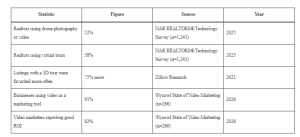
You need daily social content in your own voice. Phone-shot, agent-led content published consistently outperforms one polished video published quarterly for personal-brand building. Per NAR’s 2025 REALTORS® Technology Survey (n=1,241), 39% of Realtors named social media as their highest-quality lead source, ranking it first ahead of CRM at 23% and the MLS at 17%. Hire production for the pieces that need craft, and shoot the rest yourself.
You are testing whether video moves your business at all. Start with the $349 tier on three listings and look at saves, shares and showing requests before committing to a retainer.
How Aktion approaches this
Aktion Productions runs a three-part process called the Aktion Method, which is Plan, Roll and Cut. Plan covers scoping, shot list and location logistics including airspace, Roll is the shoot itself, and Cut is edit, color, sound and delivery in every format the client needs. The company is based in Orlando, works across both markets through its real estate videography service, and publishes its retainer pricing openly. For a broader comparison set across the state, see the best real estate video production companies in Florida.
Frequently Asked Questions
What should I look for in a real estate video production company?
Look for portfolio depth in your specific property type and price tier, a current FAA Part 107 certificate for any aerial work, a certificate of insurance that covers drone operations, written license terms describing what you can do with the video after closing, a turnaround commitment in the agreement, and commercially licensed music. A company that answers all six specifically on a first call is worth more than one with a prettier reel and vague answers.
Does a real estate videographer need an FAA license?
Any drone flight tied to a commercial purpose requires an FAA Part 107 Remote Pilot Certificate, and marketing a property for sale is a commercial purpose. The certificate requires passing a 60-question knowledge exam and a TSA background check, and the FAA assesses civil penalties in the tens of thousands of dollars per violation. Ask for the certificate number, and in controlled airspace ask how the provider will obtain LAANC authorization for your address.
How much should I pay for a real estate video?
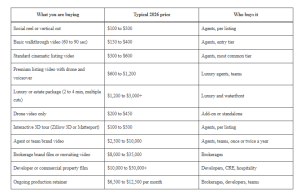
A standard cinematic listing video runs $300 to $600 for a typical home, entry-level walkthroughs start around $150 to $175 when bundled with photography, and luxury packages run $1,200 to $3,000 or more. Brokerage, developer and commercial work is priced as a project at $3,500 to $50,000 or as a monthly retainer starting around $6,500. Our cost guide breaks down published 2026 rates by tier.
Do I own the footage from my listing video?
Only if the agreement says so. Most per-listing media is delivered under a non-exclusive license tied to the active listing, which can exclude post-closing uses like highlight reels, listing presentations and recruiting decks. NAR advises agents to confirm permitted future uses in writing, and the VHT v. Zillow case, which ended in a $1.927 million award upheld in June 2023, turned partly on media used beyond its licensed scope.
Should I hire a videographer or a video production company?
Hire an individual videographer for per-listing work where speed and cost matter and the creative is standard. Hire a production company for brand films, recruiting video, developer campaigns and anything requiring a crew, direction, on-camera talent or motion graphics. The difference shows up most in projects with multiple locations, multiple shoot days or a creative concept that has to be built before anyone picks up a camera.
How long does a real estate video take to produce?
Per-listing video is typically shot in one to three hours on site and delivered in 24 to 72 hours. Brand and campaign production runs two to eight weeks from kickoff to final delivery, because it includes pre-production, scheduling around talent and locations, and multiple revision rounds. Ask for the turnaround to be written into the agreement, since this is the most common source of disappointment in per-listing work.

Looking for a Top Rated Orlando Video Production Company?
Use Orlando's Trusted Choice
Don't settle for subpar video content. With years of experience in both corporate and creative video production, we are the trusted choice for Orlando video production. Whether you're looking to capture your brand's story or create compelling advertising campaigns, we have the expertise to make your vision a reality.