Choose an Orlando event video production company by verifying four things in this order: that they have shot your specific event format before, that they can produce a certificate of insurance naming your venue as additional insured, that their quote lists deliverables and turnaround dates rather than “coverage,” and that they have worked inside your actual venue. Most planners get this backwards, they start with the demo reel and the price, then discover in week two that the vendor cannot get a load-in credential at the Orange County Convention Center or has never pulled a clean audio feed from a house mixer. Below is the full vetting process, real 2026 pricing, and the Orlando-specific venue traps that generic hiring guides never mention.
What does an event video production company actually do?
An event video production company captures a live event on video and turns the footage into finished deliverables — highlight reels, session recordings, attendee testimonials, sponsor content, and social cuts. This is different from three adjacent things people confuse it with:
- A videographer is one person with a camera. Useful for a single-room, single-day event. Not equipped for concurrent sessions or livestream.
- An AV company runs the room — screens, projection, house audio, staging. Some record; most record badly, because recording is a byproduct of their setup, not the point of it.
- An event production company builds the event experience: staging, lighting, scenic, show calling. Video may be subcontracted.
An Orlando event video production company sits closest to the marketing outcome. The output is content your organization uses after the event ends, which is the whole reason to spend the money.
Why choosing an event video company in Orlando is different from anywhere else
Orlando is not a normal video market. It is the largest meetings market in the country, and that changes both who is available and what your vendor has to be able to do.
Orlando has been named the No. 1 meeting destination in North America by Cvent for more than a decade running, according to Visit Orlando. The Orange County Convention Center, roughly 7 million square feet, the second-largest convention center in the United States, hosted approximately 1.8 million attendees across 173 events in the fiscal year ending September 2025, generating $4.2 billion in economic impact, per Visit Orlando. A $560 million expansion adding a 100,000-square-foot ballroom broke ground in 2026, with completion targeted for 2029.
Three practical consequences follow from that, and they should shape your hiring:
1. Crew supply collapses during citywide weeks. When the PGA Show (33,000+ attendees in 2025) or VMX (nearly 30,000) is in town, every experienced camera operator, audio tech, and editor in Central Florida is booked. A company that says yes to your February date without checking its crew roster is either lying or about to subcontract to whoever is left. Ask when they last had to turn down work — a real answer signals a real calendar.
2. Venue rules here are unusually strict. Between the OCCC, the resort convention hotels along International Drive, and the theme park venues, Orlando has a dense concentration of properties with in-house AV exclusivity, outside vendor fees, and rigorous credentialing. A crew that only shoots in offices and event halls will hit a wall.
3. Your competition for attention is fierce. Cvent’s research finds that imagery and video influence 48% of the decision to even send an RFP to a venue (see more Orlando event statistics). In a market where every association is producing a recap reel, generic coverage does not move anything.
The 7 questions that separate a real event video company from a person with a camera
Ask these on the first call. The wrong answers are more informative than the right ones.
1. “Have you shot this exact format before, and can I see the full deliverable, not the reel?” A sizzle reel is a highlight of highlights. It proves someone can edit 45 seconds. Ask to see a complete 3-minute recap and a full session recording from a real client, a serious company’s portfolio will include both. Good answer: they send two or three unlisted links within a day. Red flag: they only ever show the reel.
2. “How many camera operators are on site, and who is running audio?” Audio is where event video dies. Bad audio makes good footage unusable; good audio rescues mediocre footage. Good answer: a named person whose only job is audio, plus a plan for a board feed and a backup lav or shotgun recording as insurance. Red flag: “the cameras have mics on them.”
3. “Walk me through your redundancy plan.” Live events do not have second takes. Good answer: dual card recording in every camera, backup batteries, a second audio recorder, footage offloaded to two drives before the crew leaves the building, and one copy leaving the site separately. Red flag: any hesitation.
4. “Who specifically is on site — and are they employees or day-hires?” Subcontracting is normal and fine. Undisclosed subcontracting is not. Good answer: they name the lead and explain their vetting for supplemental crew. Red flag: “our team will be there.”
5. “Can you produce a COI naming my venue as additional insured, and what are your limits?” Filming on public property in Orlando requires a general liability policy of $1,000,000 per occurrence with the city or county named as additional insured, per Film Orlando’s permitting guidance. Most private venues require the same. Good answer: they have done it a hundred times and can turn one around in 48 hours. Red flag: they ask what a COI is.
6. “What is the turnaround on each deliverable, and what does ‘rush’ cost?” Get dates, not adjectives. Good answer: specific business-day counts per deliverable and a written rush rate. Red flag: “a few weeks.”
7. “What happens to the raw footage after delivery?” See the ownership section below. Good answer: a clear archive policy with a duration and a stated cost to deliver raws. Red flag: vagueness, or a policy that quietly makes you re-hire them for every future edit.
For a broader vetting framework that applies beyond events, see 9 critical questions to ask a videographer.
Freelancer, production company, or your venue’s in-house AV team?
All three can be correct. The mistake is picking one without knowing what you gave up.
| Solo freelancer | Event video production company | Venue in-house AV | |
|---|---|---|---|
| Typical day rate | $700–$2,000 | $1,500–$3,500+ (producer-led crew) | Bundled into AV package |
| Best for | Single room, single day, one deliverable | Multi-room, multi-day, multiple deliverables, livestream | Session capture as an add-on to AV you’re already buying |
| Concurrent sessions | No | Yes | Sometimes |
| Marketing-grade edit | Varies wildly | Yes | Rarely — capture, not storytelling |
| Redundancy if someone gets sick | None | Yes | Yes |
| Avoids outside vendor fees | No | No | Yes |
| Biggest risk | Single point of failure | Paying for scope you don’t need | Footage that technically exists but nobody wants to watch |
The honest heuristic: if the video’s job is archival — record the keynote so members who missed it can watch, in-house AV is often the efficient answer. If the video’s job is marketing, sell next year’s event, prove impact to a board, close sponsors, you need an event video production company in Orlando whose deliverable is the edit, not the recording. If you are building a shortlist, start with the top event video production companies in Orlando.
For a nonprofit gala, this distinction decides the outcome. A recording of your program is a compliance artifact. A four-minute film that intercuts the honoree’s story with room reaction and a donor’s on-camera sentence about why they gave is a fundraising asset you will use for eighteen months.
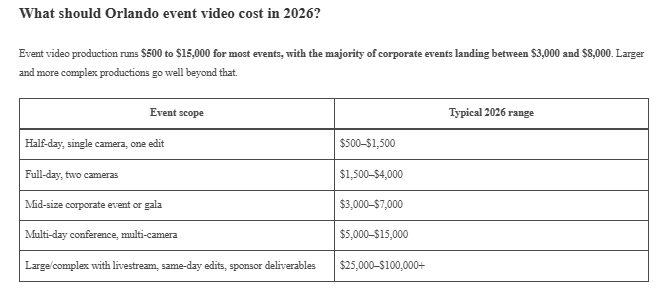
What should Orlando event video cost in 2026?
Event video production runs $500 to $15,000 for most events, with the majority of corporate events landing between $3,000 and $8,000. Larger and more complex productions go well beyond that.
| Event scope | Typical 2026 range |
|---|---|
| Half-day, single camera, one edit | $500–$1,500 |
| Full-day, two cameras | $1,500–$4,000 |
| Mid-size corporate event or gala | $3,000–$7,000 |
| Multi-day conference, multi-camera | $5,000–$15,000 |
| Large/complex with livestream, same-day edits, sponsor deliverables | $25,000–$100,000+ |
Underlying labor: a two-person camera-and-sound crew runs roughly $900–$1,500 per day, while a fuller producer-led crew runs $2,000–$3,500 per day before rentals or post-production, according to D-MAK Productions’ 2026 event video cost guide. Editing typically runs $75–$150 per hour, at one to three hours of edit time per finished minute.
The single most misunderstood driver: complexity costs more than duration. Adding a second day to a single-room shoot is close to linear. Adding a second concurrent room, a livestream, or a same-day edit is not, each one is a separate crew, a separate workflow, and a separate failure point. For a deeper breakdown of what drives each line item, see Aktion’s full event video production pricing guide.
How to compare three quotes without getting fooled
Quotes for event video are nearly impossible to compare because nobody scopes them the same way. Normalize them yourself before you look at a single price.
Build a one-page scope document and send the identical version to every bidder:
- Event dates, venue, and exact call times — including load-in and load-out windows
- Rooms and sessions to be covered, with a note on which are simultaneous
- Deliverables list with runtimes — e.g., one 3-minute recap, six 30-second vertical social cuts, eight full session recordings, twelve attendee testimonials
- Turnaround date for each deliverable
- Aspect ratios and captions required — 16:9, 9:16, 1:1; burned-in or SRT
- Music licensing — who provides and who pays
- Revision rounds included
- Raw footage and archive terms
- Travel, parking, and per diem — Orlando venue parking is a real line item
- Who is responsible for venue fees — patch fees, power, outside vendor charges
Then compare quotes on cost per deliverable, not total price. A $9,000 quote producing fourteen usable assets beats a $6,000 quote producing three.
Watch for the two most common quote distortions: unpriced revisions (a vendor who includes one round and charges $500 for each additional will land above a higher initial bid) and runtime creep (a “highlight reel” with no stated runtime can arrive at 90 seconds when you needed four minutes).
The Orlando venue logistics that quietly wreck event video
This is the section no other hiring guide writes, and it is where Orlando budgets actually break.
In-house AV exclusivity and outside vendor fees. Many convention hotels and large venues designate an exclusive AV provider. Bringing your own video crew can trigger an outside vendor fee ranging from about $1,000 for smaller events to $10,000+ for large conferences. Ask your venue contract manager about this before you sign the video contract, not after.
Patch fees. Pulling a clean audio feed from the house mixer — the single most important technical thing your video crew will do, commonly costs $200–$500 per patch. It is not optional. A crew that plans to record ambient room audio instead is handing you unusable keynote footage.
Power and rigging. A single 100-amp power drop can run $500–$1,200, and rigging or hanging points for overhead positions commonly run $2,000–$5,000. Most event video does not need rigging. If your vendor proposes a jib or overhead camera, ask what the venue charges before you approve it.
Labor minimums and overtime. Venue labor minimums are commonly four hours, with overtime billed at 150–200% of standard rates, meaning a half-hour program overrun can add $300–$600. Build a buffer into the call sheet.
Bandwidth for livestream. Venue internet packages adequate for streaming run $500–$3,000+. Convention center Wi-Fi is not a livestream plan. Insist on a hardwired drop with a stated upload commitment.
Permits and noise ordinance. Filming on public property across Orange, Seminole, and Osceola counties generally requires a permit with a minimum of five business days’ processing, per Film Orlando. The City of Orlando enforces a noise ordinance from 10 PM to 7 AM. Winter Park requires seven business days and can charge up to $500 daily. If your gala includes exterior B-roll or a step-and-repeat on a public sidewalk, this applies to you.
For events at Orlando venues specifically, a vendor’s answer to “which rooms at this property have you shot in?” is worth more than their reel.
What deliverables should you ask for, and when should they land?
Vague deliverables are the number one source of post-event disappointment. Specify runtime, format, and date for every item.
| Deliverable | Typical turnaround | What it’s for |
|---|---|---|
| Same-day or next-morning teaser (30–60 sec) | 2–12 hours | Social momentum during a multi-day event; day-two attendance |
| Daily highlight recap | Overnight | Playback on venue screens; conference app |
| Post-event highlight reel (2–4 min) | 2–4 weeks | Selling next year’s event; sponsor renewals |
| Full session recordings | 2–4 weeks | On-demand library, member value, gated content |
| Attendee/exhibitor testimonials | 3–4 weeks | Sales enablement, case studies, corporate video libraries |
| Vertical social cuts (6–12) | 3–4 weeks | The highest-ROI deliverable per dollar, and the one most often forgotten |
| Sponsor-specific edits | 3–4 weeks | Sponsorship fulfillment and upsell |
| Raw footage archive | At delivery | Future edits without a reshoot |
Two recommendations most planners skip. First, budget for vertical cuts explicitly. They cost little marginal editing time and outperform the hero reel on every social platform. Second, request a same-day teaser for any event running longer than one day. Posting a 45-second cut on night one measurably drives day-two energy, and it is the cheapest deliverable on the list.
Who owns the footage — and did you clear the right to use it?
Two contract issues cause more post-event problems than any technical failure.
Raw footage ownership is not automatic. In U.S. practice, absent a written agreement, the production company that shot the footage generally holds the copyright in it, a work-for-hire or explicit assignment clause is what transfers ownership to you. Many vendors deliver only the finished edits and retain the raws, which means every future edit requires re-hiring them. Decide what you want and put it in writing. Requesting an archive of raw footage is reasonable; expecting it for free after the fact is not.
Get releases signed before people are on camera. For conferences, this means a recording clause in your speaker agreements, a keynote you cannot publish because the speaker never agreed to be recorded is a total loss. For attendees, standard practice is signage at registration plus a line on the registration form. For nonprofit events involving beneficiaries, minors, or anyone whose participation is sensitive, use individual written releases and brief your crew on who is off-limits. Ask your vendor whether they supply release forms and who collects them on site. Good ones do; it should be in the scope.
Red flags: when to walk away
- No COI, or a delay in producing one. This is a five-minute task for a legitimate company.
- A quote with no deliverables list. “Full-day event coverage — $4,500” is not a scope of work.
- Only reel footage, never full deliverables. They may be editing around problems.
- No audio specialist for a multi-room event. Cameras cannot cover audio for concurrent sessions.
- No questions about your goals. A vendor who does not ask what the video is for will produce footage that serves no purpose.
- Unwilling to name the on-site crew. You are buying people, not a logo.
- Wildly lowest bid. In a market where a producer-led crew day starts around $2,000, a $1,200 multi-camera conference quote means someone is being cut — usually audio, usually redundancy.
- No site visit or venue walkthrough offered for a five-figure event.
Your pre-signature checklist
Before you sign, confirm you have all ten in writing:
- Full deliverables list with runtimes, formats, and aspect ratios
- A specific delivery date for each deliverable
- Named on-site crew roles, including a dedicated audio operator
- COI issued and accepted by the venue
- Redundancy plan — dual recording and offsite backup before crew departs
- Confirmation of who pays venue patch, power, and outside vendor fees
- Number of revision rounds included and the cost per additional round
- Music licensing responsibility
- Raw footage ownership and archive duration
- Cancellation and weather terms — this is Florida, and outdoor events in hurricane season need a clause
If a vendor resists putting any of these in the contract, that is your answer.
How Aktion approaches event video in Orlando
Aktion Productions runs on a three-part process: Plan, Roll, Cut. Plan is scoping, venue coordination, shot lists, and the AV conversations that happen before anyone shows up with a camera. Roll is the shoot. Cut is the edit and delivery in the formats you actually need.
The reason Plan comes first is the entire point of this article. Most event video failures are decided weeks before the event, in the details nobody wrote down — the patch that wasn’t budgeted, the speaker release nobody sent, the vertical cuts nobody scoped. Aktion has worked events across Orlando’s venue landscape, from convention center conferences to nonprofit galas, and the pattern holds every time: the shoot is rarely the hard part.
If you are scoping an upcoming event, our Orlando event video services page outlines coverage formats and deliverables, or you can request a quote for your event.
Hiring for a nonprofit gala? Our guide to the fund-a-need video for your gala covers the appeal film itself.
Frequently asked questions
How much does event video production cost in Orlando?
Most Orlando event video projects fall between $500 and $15,000, with the majority of corporate events landing in the $3,000–$8,000 range. A half-day single-camera shoot with one edit runs $500–$1,500; a multi-day multi-camera conference runs $5,000–$15,000. Complexity — concurrent rooms, livestream, same-day edits — drives cost more than the number of days.
How far in advance should I book an event videographer in Orlando?
Book six to eight weeks out for a standard event, and three to six months out if your event falls during a citywide convention week. Orlando’s crew supply tightens sharply when large shows like the PGA Show or VMX are in town, and the experienced operators book first. Last-minute availability usually means you are getting whoever else was available.
Do I need a permit to film my event in Orlando?
Filming inside a private venue does not require a city permit, but your venue will almost certainly require a certificate of insurance naming it as additional insured. Filming on public property in Orange, Seminole, or Osceola counties generally requires a permit with a minimum of five business days’ processing and a $1,000,000 general liability policy naming the city or county as additional insured, according to Film Orlando. The City of Orlando also enforces a 10 PM to 7 AM noise ordinance.
Should I just use my venue’s in-house AV company to record the event?
Use in-house AV when the goal is archival, recording sessions so people who missed them can watch. Hire a dedicated event video production company when the goal is marketing, because in-house AV records the room but rarely produces a story-driven edit, vertical social cuts, or testimonials. Using in-house AV does avoid outside vendor fees, which can run $1,000 to $10,000+ depending on event size.
Who owns the raw footage after my event?
By default, the production company that shot the footage typically retains copyright in it unless your contract says otherwise. If you want the raw files, negotiate a work-for-hire or assignment clause and an archive delivery term before signing, asking after delivery usually costs extra. Most vendors will deliver finished edits by default and archive raws for a defined period.
What is the single most important thing to get right in an event video contract?
The deliverables list with dates. Nearly every dispute about event video traces back to a scope that said “coverage” instead of naming runtimes, formats, quantities, and delivery dates. If the contract specifies “one 3-minute recap at 16:9 with captions, delivered within 15 business days,” there is nothing to argue about later.

Looking for a Top Rated Orlando Video Production Company?
Use Orlando's Trusted Choice
Don't settle for subpar video content. With years of experience in both corporate and creative video production, we are the trusted choice for Orlando video production. Whether you're looking to capture your brand's story or create compelling advertising campaigns, we have the expertise to make your vision a reality.