Real estate video adoption is far lower than the marketing industry pretends. According to the National Association of REALTORS® 2025 REALTORS® Technology Survey (n=1,241, fielded July 2025), 52% of Realtors use drone photography or video and 38% use virtual tours, while 75% use social media and 79% use eSignature. Meanwhile, 91% of businesses across all industries use video as a marketing tool, per Wyzowl’s 2026 State of Video Marketing report (n=266). That gap between what agents have and what buyers expect is the entire opportunity, and the numbers below map it.
Every statistic on this page carries a publisher, a year, and a sample size where one was disclosed. At the end, we list six widely repeated real estate video statistics that we could not trace to a real study, along with what they are actually based on.
The five numbers worth memorizing
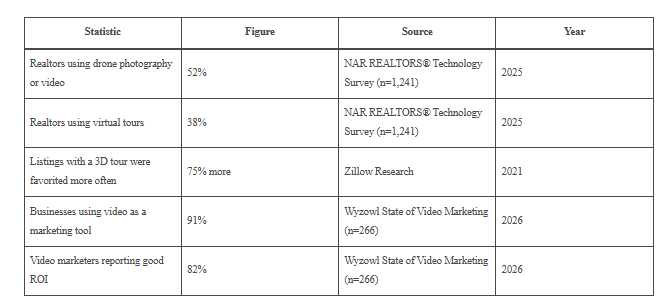
| Statistic | Figure | Source | Year |
|---|---|---|---|
| Realtors using drone photography or video | 52% | NAR REALTORS® Technology Survey (n=1,241) | 2025 |
| Realtors using virtual tours | 38% | NAR REALTORS® Technology Survey (n=1,241) | 2025 |
| Listings with a 3D tour were favorited more often | 75% more | Zillow Research | 2021 |
| Businesses using video as a marketing tool | 91% | Wyzowl State of Video Marketing (n=266) | 2026 |
| Video marketers reporting good ROI | 82% | Wyzowl State of Video Marketing (n=266) | 2026 |
How many agents actually use video, drone and virtual tours?
All figures in this section come from the National Association of REALTORS® 2025 REALTORS® Technology Survey, fielded in July 2025 to a random sample of 49,233 active REALTORS® and returning 1,241 usable responses, with a margin of error of ±2.78% at the 95% confidence level.
- 79% of Realtors use eSignature tools, making it the most widely adopted technology in the survey.
- 75% of Realtors use social media in their business.
- 52% of Realtors use drone photography or video.
- 46% of Realtors use AI-generated content.
- 38% of Realtors use virtual tours.
- 70% of Realtors report using at least one new technology tool in the past year.
The ranking matters more than any single number, and it is the fastest way to sanity-check a vendor’s claims when you are choosing a real estate video production company. Drone and virtual tour production sit below social media and eSignature, which means visual production still works as a differentiator in most markets and has not become table stakes.
Where do real estate leads actually come from?
Also from the NAR 2025 REALTORS® Technology Survey (n=1,241):
- 39% of Realtors name social media as the technology tool that generated the highest quality leads, ranking it first.
- 23% name their CRM.
- 17% name their local MLS.
- 13% name their brokerage website.
- 12% name digital advertising campaigns.
- 12% name their personal website.
- 9% name listing syndication portals.
Social media beating the MLS by 22 percentage points is the single most useful data point for anyone arguing that video production budget belongs in social-first formats.
What do agents spend on technology and lead generation?
From the same NAR 2025 survey (n=1,241):
- 34% of Realtors spent $50 to $250 per month on technology over the prior 12 months.
- 20% spent $251 to $500 per month.
- 24% spent more than $500 per month.
- 27% spent $50 to $250 per month specifically on lead generation.
- 82% of Realtors say clients responded positively or very positively to the technology they use.
- 38% agree and 29% strongly agree that their brokerage provides the tools they need.
How is AI changing real estate content production?
From the NAR 2025 REALTORS® Technology Survey (n=1,241):
- 41% of Realtors currently use AI or generative AI tools.
- 20% use AI daily.
- 22% use AI weekly.
- 27% use AI a few times per month.
- 32% have never actively tried AI.
- 58% of Realtors who use AI use ChatGPT, making it the most used tool by a wide margin.
- 20% use Google Gemini.
- 15% use Microsoft Copilot.
- 21% use a CRM with built-in AI insights.
- 7% use chatbots for lead capture.
- 1% use digital twins.
- 17% report a significantly positive impact on their business from AI.
- 33% report a moderately positive impact.
- 46% report no noticeable impact.
- 4% report a negative impact.
Half of the agents using AI report no measurable business effect, which is a useful counterweight to the assumption that AI video tools have already displaced production budgets.
What do buyers do with video and virtual tours?
This is the weakest evidence base in the entire category, because NAR has not published a dedicated digital-behavior report since 2018. The numbers below come from that report, and anyone citing them in 2026 should say so plainly.
- 46% of buyers who used the internet in their home search found virtual tours “very useful,” per NAR’s Real Estate in a Digital Age report, 2018.
- 37% of buyers used an online video site as an information source during their home search, per the same 2018 report.
- Both younger and older Baby Boomers used online video sites more frequently than other age groups in that survey, which runs against the common claim that video is a millennial-only channel.
From NAR’s 2025 Profile of Home Buyers and Sellers, based on 173,250 surveys mailed and 6,103 responses covering transactions between July 2024 and June 2025, with a ±1.25% margin of error:
- 88% of home buyers purchased through a real estate agent or broker.
- 50% of buyers said the most valuable thing their agent did was help them find the right home.
- Buyers searched for a home for 10 weeks on average, unchanged from the prior year.
What does listing engagement data say about 3D tours?
All figures from Zillow Research, published June 2021. Engagement figures cover March 2020 through February 2021.
- Listings with a Zillow 3D Home tour were favorited 75% more often than listings without one.
- Listings with a 3D tour were viewed 65% more often.
- 79% of home shoppers said they wanted the ability to view a 3D virtual tour (Zillow survey, February 2021).
- 79% also wanted access to digital floor plans.
- Listings featuring 3D tours in April 2021 were three times higher than 2019 levels.
- Open houses in April 2021 were down 42% from 2019 levels.
- Before the pandemic there were 8.2 open houses for every 3D virtual tour, and by April 2021 that ratio had compressed to 1.6.
These are the strongest listing-level engagement numbers that exist in public real estate data, and they are five years old. Treat them as directional, because the market they describe has moved on.
How does video perform as a marketing channel generally?
All figures from Wyzowl’s State of Video Marketing 2026, surveying 266 marketing professionals and online consumers in late 2025.
- 91% of businesses use video as a marketing tool.
- 93% of video marketers say video is an important part of their overall strategy.
- 82% say video marketing delivers good return on investment.
- 93% say video increases user understanding of a product or service.
- 93% say video boosts brand awareness.
- 85% say video generates leads.
- 83% say video directly increases sales.
- 82% say video increases website traffic and dwell time.
- 84% of consumers say they want more video content from brands.
- 85% of consumers say they have been convinced to buy something by watching a video.
- 63% of consumers prefer learning about a product through a short video.
- 71% of video marketers say videos between 30 seconds and two minutes are most effective.
- 69% of video use cases are social media videos, the leading category.
- 51% of video content created is live action.
- 63% of video marketers used AI tools to create or edit video, up from 51% the prior year.
What does real estate video actually cost?
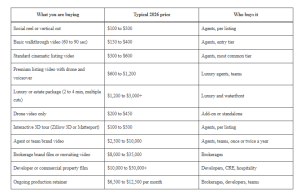
Published rates from named providers, checked September 2026. Full breakdown in our real estate video production cost guide.
- Real estate videography runs $150 to $900 on average nationally, according to cost data compiled by Fash from reported member project costs.
- A video walkthrough runs $250 to $600, per the same data set.
- Drone video alone runs $200 to $450.
- An interactive 3D tour runs $100 to $360.
- Shooting rates run $80 to $200 per hour and editing runs $70 to $180 per hour, per Fash.
- Jet Media Productions (Orlando) publishes a photo-plus-video package at $349 and a photo, video and 3D tour package at $499.
- My Visual Listing (Orlando) publishes cinematic walkthrough video starting at $175, aerial drone video at $299, and a Zillow 3D Home tour starting at $110.
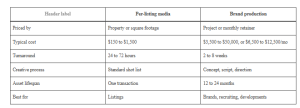
- Aktion Productions publishes a Signature monthly retainer starting at $6,500 and a Studio retainer starting at $12,500, which is the brokerage and developer tier rather than the per-listing tier.
For a state-level view of who operates at each of these tiers, see the best real estate video production companies in Florida and Aktion’s Orlando real estate videography page.
Six real estate video statistics you should stop repeating
Every one of these appears on dozens of agency blog posts, usually attributed to NAR. None of them survives a source check. We are listing them because citing a fake number in a listing presentation is a credibility problem waiting to happen.
1. “Listings with video receive 403% more inquiries.” Usually attributed to NAR or to an unnamed Australian real estate body. NAR has never published this figure. The trail leads back to a single agency’s uncorroborated marketing claim from the early 2010s, and the sample, methodology and control group were never published.
2. “73% of homeowners would rather list with an agent who uses video.” Frequently attributed to NAR. The NAR Profile of Home Buyers and Sellers does not ask this question. The number has circulated since roughly 2016 with attributions that change depending on who is repeating it.
3. “Homes marketed with video sell 68% faster.” There is no published study behind this. A 32% version circulates as well, and it traces to unpublished internal data from a single vendor. Both figures also ignore the obvious confound, which is that higher-priced and better-presented homes get video in the first place.
4. “Real estate video generates 157% more website traffic.” Attributed to NAR in hundreds of posts. It does not appear in any NAR research report we could locate, and the underlying claim appears to be a general marketing statistic that got reassigned to real estate somewhere along the way.
5. “Video content drives 1200% more social shares than text and images combined.” This one is real in the sense that it was published, and it comes from a 2015-era blog analysis rather than a controlled study. It is also a decade old, predates short-form vertical video entirely, and has nothing to do with real estate.
6. “80% of listing agents use drone photography.” NAR’s own 2025 Technology Survey puts it at 52%. The 80% figure appears to come from a vendor blog citing a vendor blog.
If you need a defensible number for a listing presentation, use the NAR Technology Survey figures in this article. They come with a sample size, a fielding date and a margin of error, which is exactly what a skeptical seller is looking for.
How to cite these statistics
Link to the original source whenever it is publicly available, and use this page as the index. NAR’s REALTORS® Technology Survey and Profile of Home Buyers and Sellers are both published at nar.realtor. Zillow Research posts are at zillow.com/research. Wyzowl publishes its State of Video Marketing report annually at wyzowl.com.
If you quote a figure in a listing presentation or a pitch deck, include the year. Real estate technology adoption moved substantially between 2019 and 2025, so a 2021 engagement number and a 2025 adoption number are describing different markets.
Frequently Asked Questions
What percentage of real estate agents use video in 2026?
There is no single clean figure for video, because NAR’s 2025 REALTORS® Technology Survey measures drone photography or video at 52% and virtual tours at 38% without a separate line item for listing video. The honest answer is that roughly half of agents have some form of aerial or video capability in their marketing, and adoption of full cinematic listing video is considerably lower than that.
Is the “403% more inquiries” real estate video statistic true?
No verifiable study supports it. The figure is usually attributed to the National Association of REALTORS®, which has never published it, and the original claim traces back to a single agency’s marketing material with no published methodology. Use NAR’s Technology Survey adoption figures or Zillow’s 3D tour engagement data instead, because both come with disclosed sources.
Do homes with video sell faster?
Public data does not answer this cleanly. Zillow Research found that listings with a 3D Home tour were viewed 65% more often and favorited 75% more often between March 2020 and February 2021, which measures engagement rather than days on market. The widely quoted “68% faster” claim has no published study behind it.
How much does a real estate listing video cost in 2026?
Published rates from named providers run roughly $150 to $900 for a per-listing video, with cinematic walkthroughs starting around $175 and drone video around $300. Brokerage-level and developer-level video production is priced as a monthly retainer instead, typically starting in the $6,500 range. Our cost guide breaks down every tier with published figures.
What is the best source for real estate marketing statistics?
The National Association of REALTORS® publishes the two most reliable annual data sets, which are the REALTORS® Technology Survey for agent-side behavior and the Profile of Home Buyers and Sellers for consumer-side behavior. Both disclose sample size, fielding dates and margin of error. Zillow Research is the best public source for listing-level engagement data, though its most-cited video findings date to 2021.

Looking for a Top Rated Orlando Video Production Company?
Use Orlando's Trusted Choice
Don't settle for subpar video content. With years of experience in both corporate and creative video production, we are the trusted choice for Orlando video production. Whether you're looking to capture your brand's story or create compelling advertising campaigns, we have the expertise to make your vision a reality.